EXTRAS
PERSONAL EXPERIENCE STORIES
PERSONAL EXPERIENCE STORIES
FRED ROSE'S TRUCKS
OR
WHAT'S IN A NUMBER ANYWAY?
OR
WHAT'S IN A NUMBER ANYWAY?
by
Dave Careless
September 2026
Dave Careless
September 2026
About the author: Dave Careless was born March 13, 1948 in Rotherham, in the coal-mining district of South Yorkshire, England. His father, Tom Careless, was working in the wages office of the National Coal Board at Aldwarke and Silverwood pits when he received a job offer in the autumn of 1957 to come to Bell Island to work at DOSCO's Main Office, where he would be in charge of production and projections, determining how much ore was being produced and how much was required to fill the order books. Tom came on his own to get the lay of the land and was quickly promoted to Assistant to the General Manager (a position he held until the mines closed in 1966). In March of 1958, 10-year-old Dave and his mother, Jennie, arrived in Newfoundland. Dave has written 8 other stories about his life and adventures on Bell Island between 1958 and 1965, when he graduated from high school and left to further his studies. Like so many of us, Dave left Bell Island, but Bell Island never left him. You can read all his stories on this website by clicking on “Extras” in the top menu, then “Personal Experience Stories” in the drop-down menu. In this story, he reminisces about his childhood fascination that started with the numbering system for buses in England and, lacking buses on Bell Island, transitioned to the fleet of dump trucks operated by Fred Rose.
Below is a June 1958 photo of Dave Careless on the Sports Field a few months after moving from England to Bell Island. Photo by Jim Wai Sun.
Below is a June 1958 photo of Dave Careless on the Sports Field a few months after moving from England to Bell Island. Photo by Jim Wai Sun.

The photo below is of some of the buses that Dave left behind in England when his family moved to Bell Island. The No. 77 bus service ran between Sheffield, Rotherham and Doncaster, where this photo was taken about 1962. The front of the bus shows its number: 100 (FET800).

Before Bell Island, I had been living in Rotherham in a council house with my parents for the first nine years of my life. For quite a few years before we left, I’d been fascinated with the local buses in the town.
The interest in the buses, of course, led to a similar fascination with their fleet numbers, which were usually in a logical sequence mirrored by the numbers on their registration plates; for instance, the dozen Bristol double-deckers dating from 1949, with fleet numbers 100-111, had registration numbers FET800-811, the letters ET reflecting a vehicle registered in Rotherham. Different towns throughout the country had different registration letters, for instance, the letters DT were allocated to the neighbouring Yorkshire town of Doncaster, hence all vehicles registered in Doncaster, including its town buses, would be registered in a series ranging from ADT 1-999 through to XDT 1-999. I know, not something that would interest most people, I grant you, but it definitely kept nine-year-old me busy!
I was disappointed when I had to leave Rotherham and its buses, as I could no longer enjoy my hobby of keeping notebooks filled with their numbers; plus, I knew all the various types and styles of bodywork to quite a remarkable degree, considering I was only nine years old when I left. Although there were only two very old buses on Bell Island in 1958, with no numbers on them worth writing down in a notebook anyway, there were other vehicles running about to pique my interest, and I soon developed a similar fascination with Fred Rose's 'Enterprise Construction & Contracting' dump trucks. There were plenty at the time, and lo and behold they all had a fleet number very carefully and tastefully sign-written on the pillar behind each cab door. Keeping track of all these, and writing their numbers in my tatty notebook as they passed by our house every few minutes on Bennett Street, kept me amused for hours at a time, believe me.
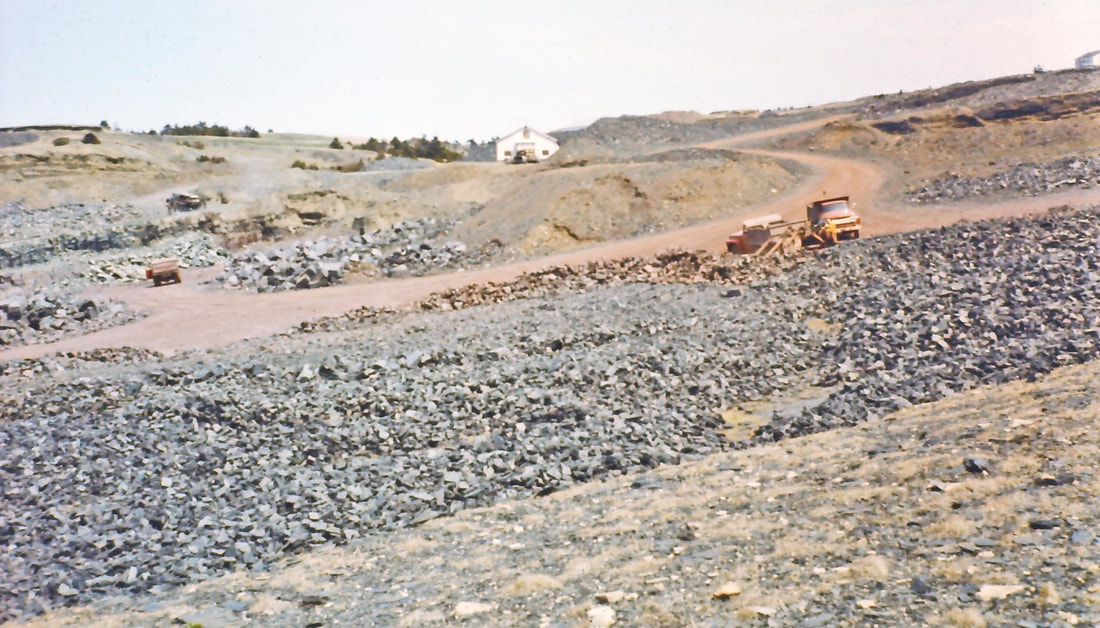
In the photo below, three of Rose's GMC trucks are at work at No. 5 Surface Mine (just west of No. 4 Mine Yard). Photo from the Southey Collection, A&SC, MUN Library.
|
M.A. Rose and Son were a trucking and excavation company based in West Mines, along with their offshoot company, Enterprise Construction & Contracting Ltd., that built roads and houses on the Island amongst other things, as well as doing general trucking, mostly for Dominion Wabana Ore, the mining company. By 1962, they also had an office in St. John's.
On the right is their advertisement from the 1965 Newfoundland Business Directory and Buyers' Guide, p. 115. |

|
Although they weren’t buses, nor were they nearly as charismatic or as well looked after as the fleet of blue and cream double-deckers that I’d left behind in Rotherham, Fred Rose’s trucks (Fred was M.A. Rose’s son, apparently) at least carried numbers that could be scribbled into a notebook whenever one was seen. It turned out that the regular sightings of the red trucks of Fred Rose passing our front door was directly related to our moving from the Bennett Street house a few hundred yards over to Greenwood Avenue in the fall of 1959.
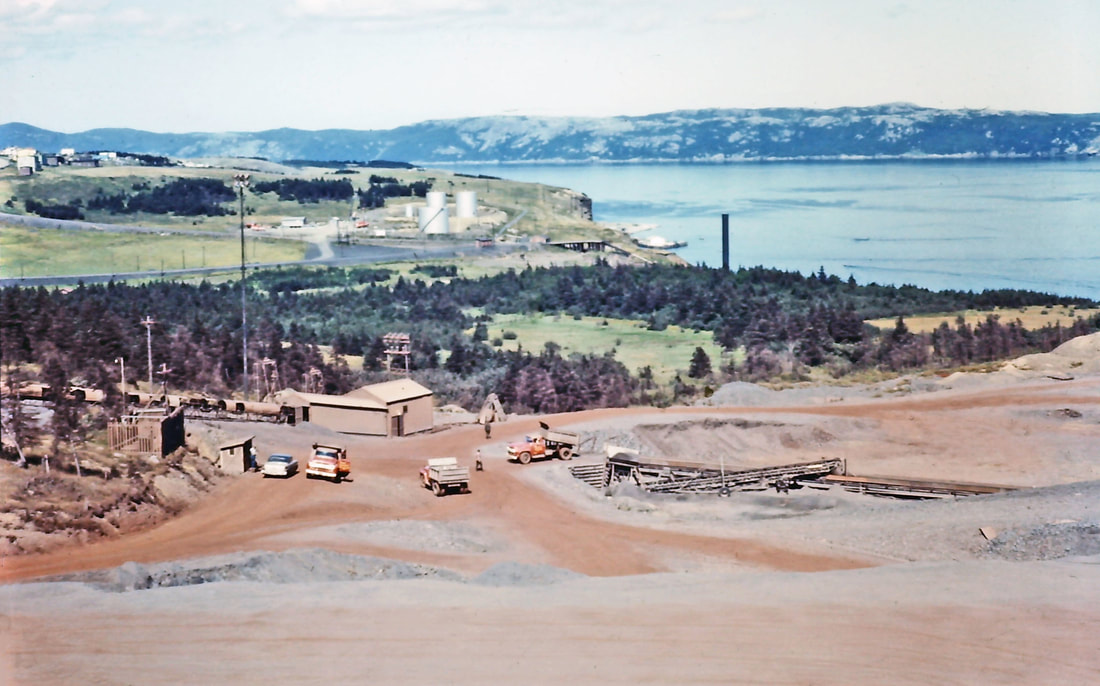
In the Southey photo below of the construction road leading to the Sizing Plant at Scotia Pier, there are three of Rose's GMC trucks (I think there were six in all, numbered sequentially 1 to 6) and you can see on the one that is displaying its side to the camera, and on another fortuitously that has its door open, the white lettering on the red cab sides, which read 'Enterprise Construction and Contracting Ltd.' Their white fleet numbers were painted on the sides also, just ahead of the cab door on each side.
In the Southey photo below of the construction road leading to the Sizing Plant at Scotia Pier, there are three of Rose's GMC trucks (I think there were six in all, numbered sequentially 1 to 6) and you can see on the one that is displaying its side to the camera, and on another fortuitously that has its door open, the white lettering on the red cab sides, which read 'Enterprise Construction and Contracting Ltd.' Their white fleet numbers were painted on the sides also, just ahead of the cab door on each side.
Of the various items of equipment that Fred Rose had at West Mines, and there was quite a large field of it behind his garage on the main road, some of it worn out and dumped, and other vehicles and heavy machinery still in use, there was a small fleet of English-built Commer dump trucks, painted red, with ‘Enterprise Construction & Contracting’ stenciled on their cab doors. I no longer have the relevant notebook (!), but I believe there were nine of these trucks: they were numbered 36-44 to the best of my recollection, with their numbers nicely hand-painted in gold leaf on the pillar behind the cab door. These nine Perkins-engined Commers were raucous machines, and could be heard coming for most of the length of Bennett Street, which of course was a bonus as it gave me plenty of time to get the notebook and pencil ready for when whichever one it was rumbled by! The reason for their regular appearance at all hours of the day along Bennett Street was that they were hauling rock from No. 3 Yard, presumably spoil from the concentrator, out the East Track to a location about a quarter of a mile or so along there, where the rock was being tipped to provide a base for five new houses to be built. It had been a rather low lying, swampy sort of area before the build-up of rock began, and when the site was ready for the actual building to commence, the level was quite a bit higher than the level of the East Track, so goodness knows how many tons of rock had been hauled there. The cul-de-sac so formed became colloquially known as ‘Snob Hill’ simply because the five houses were attractive modern bungalows occupied by various management personnel and their families.
Below is the large Company house on the corner of Bennett and Bown Streets where Dave had a good view of the Enterprise Construction trucks as they drove past with their loads of waste rock that formed the foundation for the houses on Snob Hill (now named DOSCO Hill). Photo by Tom Careless.
Below is the large Company house on the corner of Bennett and Bown Streets where Dave had a good view of the Enterprise Construction trucks as they drove past with their loads of waste rock that formed the foundation for the houses on Snob Hill (now named DOSCO Hill). Photo by Tom Careless.

The Commers were kept busy for several months transporting the rock to form the new street, by which time I had seen and spotted all nine of them on multiple occasions, along with newer trucks that were kept busy on the same work; they all went into the notebook too, rest assured!
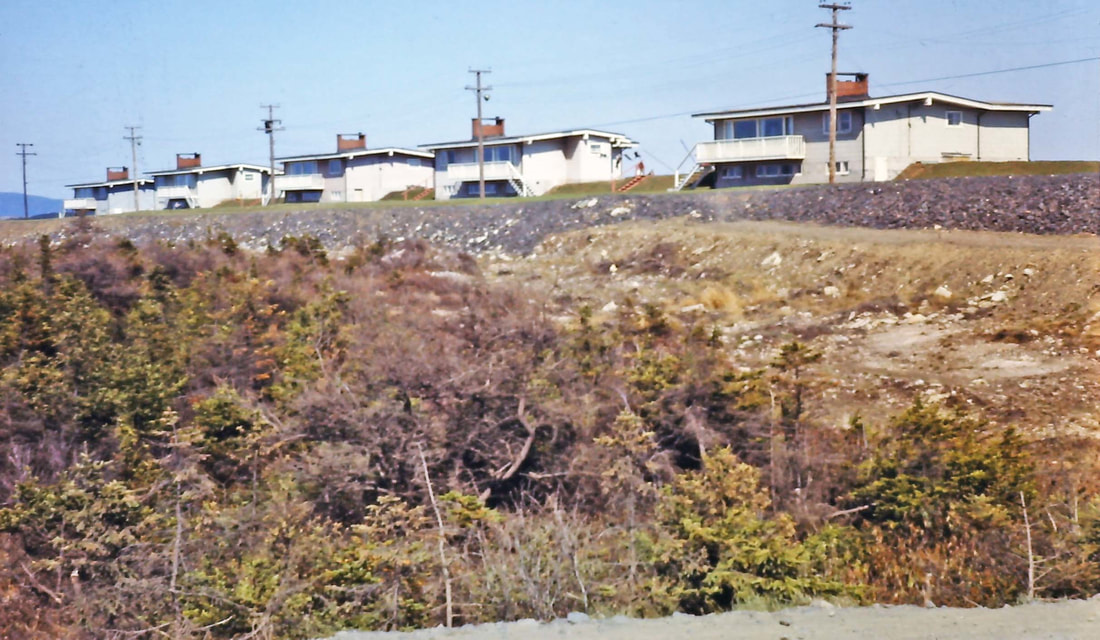
The picture below is of Snob Hill and the five Company houses shortly after they were built in 1959. The waste rock that was carried there by the Rose trucks can be seen in the space between the original swampy brush in the foreground and the newly laid lawns beside the houses. Photo from the Southey Collection, courtesy of A&SC, MUN Library.
The five houses on Snob Hill were prefabricated in Montreal, and perhaps assembled by Enterprise Construction & Contracting Company. The fifth and furthest house in from the East Track was eventually moved into by the Wabana Mines Works Superintendent, Hubert S. Haslam and his wife. When they did take up their new lodgings on Snob Hill, my folks and I moved into the Company house that they had vacated, one of four identical small houses, this being one of two on the rather unaptly named Greenwood Avenue, adjacent to the new St. Boniface Regional High School, the other two being ‘around the block’ on the East Track. This ‘new’ house, that my parents, myself and Patch took possession of in October 1959, was much more suitable for a small family of three plus a dog.
Below is the much smaller Company house on Greenwood Avenue that the family moved to in the Fall of 1959 after construction on Snob Hill was finished. The house in the background on the right is one of the two houses on the East Track (now called Steve Neary Boulevard) that are identical to this one and shows the back view of the house. Photo by Dave Careless.
Below is the much smaller Company house on Greenwood Avenue that the family moved to in the Fall of 1959 after construction on Snob Hill was finished. The house in the background on the right is one of the two houses on the East Track (now called Steve Neary Boulevard) that are identical to this one and shows the back view of the house. Photo by Dave Careless.

The fleet of Commers, likely worn out from hauling all that rock, had disappeared from the scene, perhaps consigned to the dump/scrapyard which was the field directly behind Fred Rose's West Mines garage. In any event, it was no longer necessary to keep the notebook handy, which meant, from my point of view, that there was really no need to stay on Bennett Street a moment longer anyway!
Numbering My Hilroy Exercise Books

With the disappearance of Fred's Commers and GMC trucks, I was unfortunately left without any numbers to scribble in my notebook any more, until I came up with what I considered the ideal solution. I would assign numbers to my school exercise books and scribblers! Do you recall those Hilroy exercise books, with the name and address panel on the back cover as well as the makings of a daily class timetable, and also the thicker versions, scribblers we called them, which were considerably thicker and formed of a much cheaper quality, more 'pulpy' sort of paper, usually with a nice depiction of some form of North American wildlife on the cover? Mine were just the same as everyone else's, except that mine now bore a number in the upper right-hand corner! The main difference between the numbers on the buses I so fondly remembered, or on the 'Enterprise Construction & Contracting' dump trucks, is that my scribblers and exercise books weren't numbered in any logical series! For my own amusement I numbered them in a completely random sequence, for instance ''2', ''94', '176', '28' etc. etc. Don't ask me why, I don't really know, other than that it was just for fun, and it was something to take the place of riding around on my blue Raleigh bicycle looking for Fred Rose's dump trucks in order to record their fleet numbers!
I did this for quite some time, and can recall only once being called out on it! My Grade Seven teacher at St. Augustine's, Miss Mona Ralph, was the only teacher who, on returning the homework scribblers one day, drew the attention of the class to the fact that my scribblers carried numbers in a completely illogical sequence, and questioned why, to which I was unable to provide any sort of stammered-attempt at an answer! Despite her embarrassing me in front of the rest of the class, I really liked Mona Ralph (until that day anyway!) and considered her one of the best teachers I ever had during my school years. Some years ago, after sadly finding her obituary on the Internet one day, I discovered that Mona Ralph hailed from Flat Island, Bonavista Bay. I've no idea what Flat Island was like, but I strongly suspect that there probably wasn't much in the way of machinery there that would have carried numbers worth recording in a notebook, so even if I had been able to provide an explanation for why my exercise books and scribblers carried non-sequential numbers in their top right hand corner, she very likely wouldn't have even begun to understand the explanation. And after all, when you get right down to it, what's in a number anyway?!!
Dave Careless; (currently!) no. 78!!