HISTORY
MINING HISTORY
MINING HISTORY
HISTORY/TIMELINE OF THE WABANA MINES
by Gail Hussey-Weir
Created 2021 / Updated Sept. 2026
by Gail Hussey-Weir
Created 2021 / Updated Sept. 2026
Bell Island is located in Conception Bay, Newfoundland & Labrador, Canada. It is approximately 6 miles (9.5 km) long by 2 miles (3 km) wide. The former mining district of Wabana is located on its north shore. Portugal Cove lies approximately 3 miles (5 km) by water to the east, and the capital city of St. John’s is 9 miles (14.5 km) by road from Portugal Cove.
Below is a 1951 map of Bell Island showing the position of the submarine mines, based on a map found in C.M. Anson, "The Wabana Iron Ore Properties of the Dominion Steel and Coal Corporation, Limited," in Canadian Mining and Metallurgical Bulletin, No. 473, 1951: p. 597.

In 1891, Bell Isle (as it was then known) was sparsely populated along its south side with 709 men, women and children, living in 135 households at The Beach, The Front (the area above The Beach), Lance Cove and Freshwater (west). They were Irish and English settlers who fished, farmed the rich topsoil, and carried their produce in sailing vessels to sell in St. John’s and points around Conception Bay.
On August 4, 1892, a Topsail farmer, Jabez Butler, on behalf of a group of six who would become known as “The Messrs. Butler of Topsail,” filed three applications to search for minerals at The Back (north side) of Bell Isle. Thus began events that would change the history of Bell Island forever, and would turn a quiet island into a busy center of industry for over 71 years.
In May 1893, the Butlers engaged St. John’s merchants Shirran & Pippy as their agents in finding a developer for the mining property. They contacted the New Glasgow Coal, Iron & Railroad Company of Nova Scotia (hereafter referred to as the “Scotia Company”), who happened to be looking for a reliable source of iron ore at that very time. Nova Scotia had plenty of coal for the manufacture of steel, but the company’s attempts to obtain a reliable local source of iron ore had proved futile. So it was pure coincidence, and good luck on the part of the Butlers, that they had taken out claims on what they believed to be a rich source of iron ore on Bell Island just as the Scotia Company was actively searching for iron ore for its Ferrona steel mill near New Glasgow. The Butlers did not have the finances to exploit their Bell Island holdings, and Newfoundland, which was not then part of Canada, lacked the coal needed to start a steel industry. Scotia sent their Chief Engineer, R.E. Chambers, to examine the iron ore beds in June 1893. He found a tranquil, pastoral setting, with a small population living mainly in the two natural landing spots of an island that was otherwise a fortress of steep cliffs. The iron-ore deposits, whose value he immediately recognized, were located on the uninhabited north side of the island, which he described as "heavily timbered with fir trees, and to find one's way it was necessary to make use of a compass; the south side was dotted at intervals by primitive farms."
As well, Bell Island's location just 412 miles (663 km) from the Cape Breton soft coal fields was ideal. Its position in the most easterly part of the North American Continent meant that the mines were directly on the marine track of North Atlantic shipping. Thomas Cantley, who was secretary of the Scotia Company, wrote that this was regarded as an extremely attractive feature: "...for perhaps the most necessary requirement for an iron property, after the quality and quantity of the ore shall have been assured, is its geographical position. Indeed, accessibility is fundamental. From Wabana, situated midway between Europe and America, the seaboard markets of both continents lie open."
Below is a map of the Scotia Company's "Sphere of Operations" in 1912, including the shipping route to Wabana and beyond. Image from Nova Scotia Steel and Coal, 1912, p. 3.
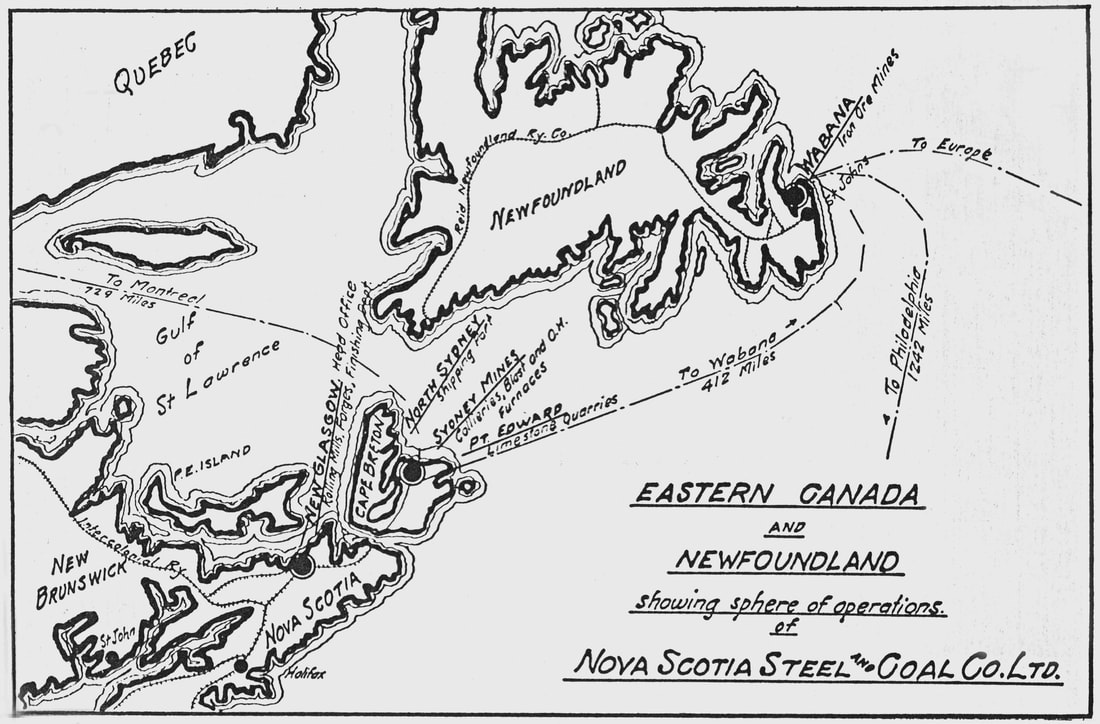
In September 1894, Scotia leased the mining rights from the Butlers, and Chambers began drawing up plans for the mining operation. Thus, with little fanfare, the fate of this small island was sealed.
In the summer of 1895, the pier and tramway across the island were built. On July 20th mining began with 160 miners, mostly Bell Islanders, employed in the surface pits.
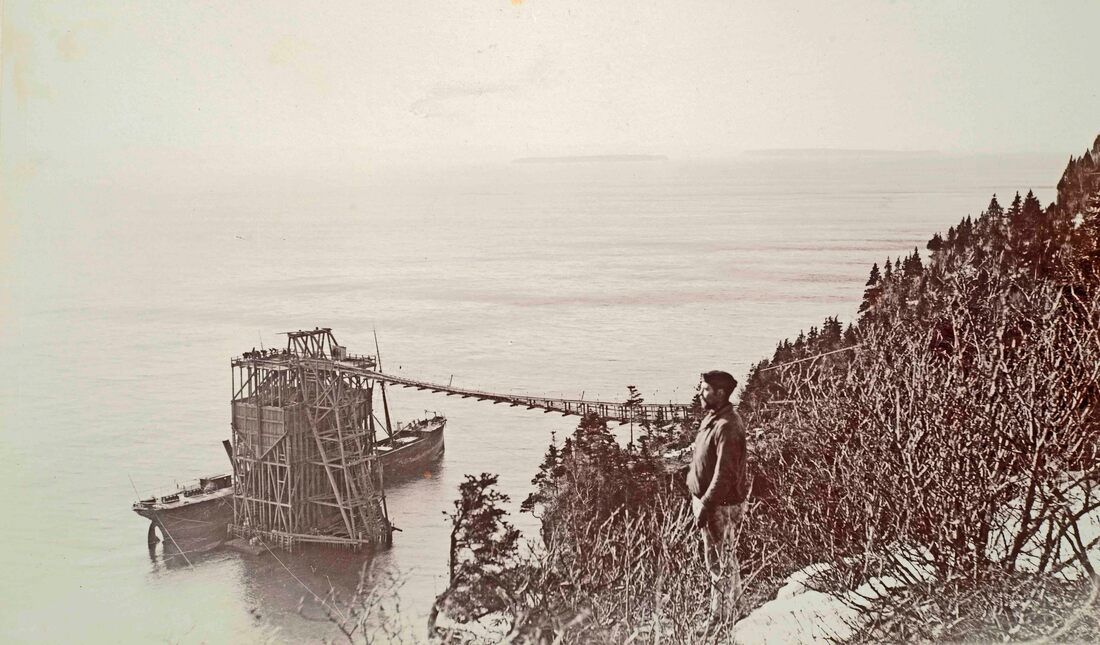
Below is a photo of the first pier, constructed by Scotia Company in 1895, located just west of The Beach in the location now known as "Dominion Pier." It was a rudimentary structure, consisting of a box-like tower erected in the water 300 feet from the cliff. It was connected to the land at the top by a swaying suspension bridge, carrying a set of tracks over which ore cars were conveyed by cables. This image appeared in an uncredited article entitled "Bell Island" in the first edition of The Newfoundland Quarterly, July 1901. The photographer, James Vey, photographed the operation for the Scotia Company in December 1895. Photo courtesy of A&SC, MUN Library, Acc. 11-148.
In September 1895, Thomas Cantley visited and named the mine site “Wabana,” an eastern Canadian Abnaki (Wabanaki) First Nations word for "Dawnland," or “the place where daylight first appears,” particularly appropriate for the most easterly mine in North America.
On Christmas Day, 1895, the first shipment of ore left for Ferrona, NS. July 3, 1896 saw the first shipment to the United States, and on November 22, 1897, the first trans‑Atlantic shipment left for Rotterdam. Operations were seasonal, starting in late spring after the Arctic ice moved out of the bay and ceasing in November.
On June 11, 1896, at the opening of the 1896 session of the House of Assembly and Legislative Council, the name of the island was given as "Bell Island," the first time this spelling of the name was used in print. Up to that time, it had always been referred to in official government documents as Bell(e) Isle or Great Bell(e) Isle, the Great being used to distinguish it from what was then known as Little Bell(e) Isle.
In May 1897, the lack of a daily mail service to Bell Island was broached in the House of Assembly, where it was stated that the place was becoming important in the economic life of the Colony of Newfoundland as 500 men were expected to be employed there that summer.
In 1898, Germany became a major customer and would remain so throughout the life of the mines. By then, 450 miners were employed.
The photo below entitled "Open Cut Mining" shows a busy Scotia Company surface mine, c.1895, courtesy of Library & Archives Canada.

In 1898, Canadian statesman, Sir Charles Tupper, proclaimed, “the iron ore of the Wabana mine will lead to the establishment of a steel industry in Sydney.” Indeed, a decade later, Chambers attributed the establishment of Canada’s first fully-integrated, primary steel-producing plant at Sydney to the deposits of iron ore at Bell Island and, as he put it, this plant transformed Sydney from “little more than a village...into a bustling cosmopolitan city.” In fact, Bell Island and Sydney had a symbiotic relationship that lasted for the life of the Wabana mines; they were each dependent on the other.
At the same time as the Scotia Company was starting operations at Wabana, American industrialist, Henry Whitney, established the Dominion Coal Company to consolidate most of the coal mines in Cape Breton. He hoped to merge with the Scotia Company to build a steel mill at Sydney. When this merger failed, he led a consortium that incorporated the Dominion Iron and Steel Company (DISCO).
Early in 1899, Scotia purchased from the Butlers the mining rights they had been leasing, then immediately sold the lower bed of ore to DISCO (known on Bell Island as “Dominion Company”), while retaining the upper bed in which the ore contained a higher iron percentage. This set the stage for a massive steel industry in Nova Scotia based on Wabana’s iron ore. Scotia used the money from this sale to purchase the Cape Breton coal mining holdings of the General Mining Association, and transferred its basic steel-making operations from Ferrona to Sydney Mines, where it began constructing its steel plant in 1900 to supply its finishing mills at New Glasgow. DISCO began constructing a basic iron and steel plant in Sydney that same year. Both plants used Wabana iron ore, with first steel produced at DISCO’s plant by the end of 1901 and at Scotia’s plant in 1902. The Sydney plants (which later merged) used Wabana ore as the sole source of supply of blast furnace ore until the 1950s, making it the foundation stone of the Cape Breton coal industry.
With 2 companies now mining on Bell Island, a second shipping pier was built and new tramways were constructed across the Island. There were now also two medical doctors, as each company employed a doctor to serve its employees, their families and others.
By 1900, there were 1,600 workers. Wabana’s first mine union was formed when Dominion tried to reduce the number of men loading ore cars. A strike ensued and brought threats of violence, which focused attention on the need for a police presence. The strike and union were short-lived, but the Island got its first court house and police station. A telegraph cable was also installed from Portugal Cove to Bell Island. With the growing industry and population came more amenities, including: passenger ferries, housing, schools, churches, shops, hotels, restaurants, telegraph and customs offices, health care, sports, fraternal and social organizations, performing arts and entertainment.
The 1901 Census listed 1,320 residents, of which 199 were employed in mining. There seems to be a contradiction when it is noted in this census that actually 1,100 men were employed in the mining operation. This was because many miners were weekly commuters, who maintained their homes in communities around Conception Bay and, thus, did not list themselves as residents of Bell Island. An illustration of the effect the mines had on the economy of Conception Bay communities is reflected in a rhyme that was popular among commuters:
Harbour Grace is a hungry place and Carbonear is not much better;
So you’ve got to go to old Bell Isle to get your bread and butter.
While on Bell Island this version was heard:
Harbour Grace is a hungry place and so is Carbonear;
But when you come to old Bell Isle you’re sure to get your share.
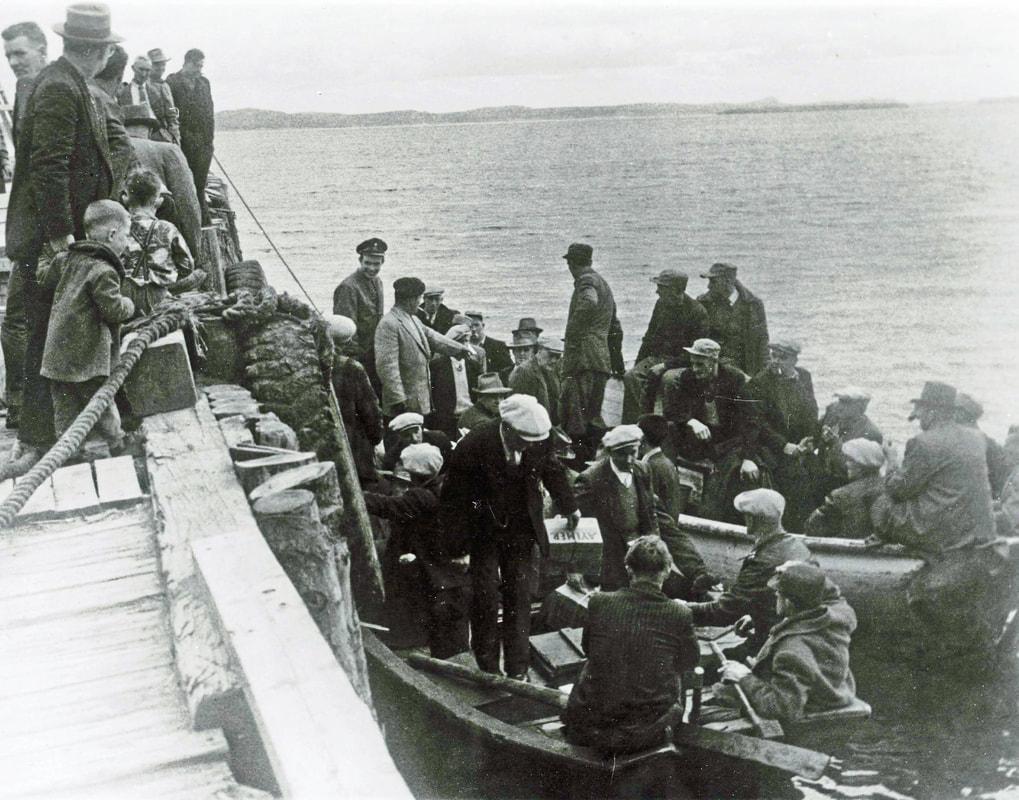
Below is a photo of miners on a Sunday evening, c.1930, arriving at the wharf on The Beach at Bell Island in small open boats from their homes around Conception Bay. Photo courtesy of A&SC, MUN Library: Coll-202.
By 1903, the depletion of surface ore saw both companies begin underground mining.
In March 1905, Scotia Company began driving the first submarine slope beneath Conception Bay. Demand for steel was such that mining was now year-round with only a break for Christmas week.
In 1906, there were no mining safety regulations, and accidents in the Wabana Mines were increasing, causing the Newfoundland Government to legislate its first Regulation of Mines Act. Among other things, it required mine inspections and accident investigations. (There were seven known deaths up to this point in the operations. By the time the mines closed in 1966, the total reached 107. Along with the deaths, there were many hundreds more injuries, some of which may have led to eventual death.)
Around 1907, electricity began replacing steam for the driving of engines and mine equipment. Scotia Company had an electrical plant adjoining their shipping pier for ventilating, draining and lighting the mine and new infrastructure was being added to prepare for submarine mining.
In 1907-08, most of the Dominion Company saddle-roof workers houses were built.
The photo below is of a range of saddle-roof miners' houses on Grammer Street built c.1907. The street was named in honour of Dominion Company's first manager on Bell Island, William S. Grammer. Many examples of this style of company house, as well as other styles, are still standing 120 years later. Photo courtesy of A&SC, MUN Library, Coll-202, Southey slides.

By 1908, 2,350 miners were employed, many being commuters, necessitating the building of more miners’ shacks and mess houses.
In the early 1900s, as mines in central Newfoundland shut down, miners experienced in all phases of underground work looked to Bell Island for employment. In the summer of 1908, miners from Pilley’s Island began arriving with their families after their mine closed down.
On Sept. 3, 1908, Sir E.P. Morris of the People’s Party opened the campaign for the election of November 2nd in the St. John’s East District at Bell Island. He was the first political leader ever to do so in Bell Island’s history, a tribute to its growing importance in the economy of Newfoundland.
In 1909, Scotia’s No. 2 Mine reached its submarine property, about 4000 feet from shore. In 1910, at 6,000 feet from shore, they were ready to start submarine mining.
By the end of 1910, eight million tons of iron ore had been shipped from Bell Island since 1895. Miners were being actively recruited from all over Newfoundland.
The two companies mining Wabana iron ore were headquartered in Canada so, until 1949 when Newfoundland became a province of Canada, the profits from this resource were going to a foreign country. Until 1910, the Newfoundland government had never entered into contracts with companies running mining operations. During the previous decade, the Legislature had discussed the idea of levying a tax on the shipment of Wabana ore out of Newfoundland, but it was not until 1910 that it was announced in the Speech from the Throne that the E.P. Morris government had reached an agreement with the two companies to pay a royalty of seven and a half cents per ton on the total output of ore for the next 10 years. The potential revenue of $75,000 annually to be derived from the ore royalty was expected to pay more than half the interest charge on the four million dollars borrowed by the Morris government to build 250 miles of branch railways. Hailed as "Morris' Masterpiece," the “Bell Island Royalty Bill” received approval of the House of Assembly on March 24th. At the end of 1910, the first royalties paid amounted to $94,668 between the two companies (equivalent to about $2.5 million in today’s money).
By 1911, Scotia Company houses on Scotia Ridge and at Bridal Avenue were being built. The Scotia Company owned 32.5 square miles of the submarine area, and DISCO owned 8.5 square miles.
1912-13 saw many advancements with the permanent population now at 3,084, and that did not include commuting miners. Amenities included 10 schools, 7 churches, 4 halls, 3 hotels, 30 shops, a Bank, a weekly newspaper, the first local council, and an enclosed skating rink. The Tramway to carry passengers and freight from the wharf at The Beach to the top of the steep hillside opened late fall 1913.
The photo below taken by Robert R. Brown is of the Beach Tramway c. 1942. The sign says: "DANGER. Waiting on the track is prohibited. Take the cars here. 10cts. to top." Photo courtesy of A&SC, MUN LIbrary: University Relations, #M11394.

In August 1914, the First World War brought everything on Bell Island to a standstill. The mines were closed for the rest of that year and all sports and amusements were cancelled. The war had a profound effect on Bell Island. The first result was the loss of overseas iron ore markets, throwing many men out of work for some months, and continuing to affect operations over the next few years. More drastically, 200 boys and men enlisted from Bell Island, 29 of whom died, with many more wounded.
It was June 1915 before both mining companies got back to production. During these war years, Dominion’s No. 2 and No. 4 mines and Scotia’s No. 3 were being driven into their submarine areas, making four submarine slopes in all.
By 1917, Bell Island’s population balance had shifted. Before mining started, no one lived on the north side of the island. Now more than half the population lived in close proximity to the mines, reasonable considering that most people walked to work. The mines area now formed its own Local Council.
In 1919, 1,500 men were working full time.
Although the war had ended in 1918, its devastating impact on the British economy was about to be felt on Bell Island. In 1920-21, British industrialists, looking to revive the economy of the United Kingdom, conspired with the presidents of Nova Scotia Steel & Coal Company (NSSCC) and Dominion Iron & Steel Company (DISCO), to create Canada’s largest corporate merger, forming the British Empire Steel Corporation (BESCO). BESCO absorbed NSSCC, DISCO, Halifax Shipyards, most of Nova Scotia’s coal mines, Aguathuna, and the Wabana iron ore properties. It was actually 1922 before this merger was applied at Wabana and the two mining operations became one.
By 1922, the post-war depression was underway. Ore was being stock-piled due to lack of markets and the mines alternated between full shut-downs and shortened work weeks. The “Whack Road” was started as a make-work program for out-of-work miners. It opened as Middleton Avenue in 1928, finally linking West Mines to Freshwater.
1923 was another bad year and many young men left for Canada and the U.S. to seek work. The large turbo-electric power plant went into operation at Dominion Pier in September.
In 1924, Wabana Mines were the largest in the British Empire and 4th on the World List of Mines. With a population of 4,400, Bell Island was made an Electoral District. Meanwhile, employment, when it existed, was restricted to the 900 workers who had their homes on the island. While Wabana miners managed to survive the low wages and sporadic unemployment of the BESCO years, their fellow coal and steel workers in Nova Scotia were organized into a strong union that had been striking whenever BESCO attempted to lower wages, cut hours or limit rights.
In 1925, when BESCO cut wages in Nova Scotia by 20%, the resulting strike turned violent with the shooting death of a miner. The ongoing strikes ultimately caused the collapse of BESCO.
In 1926, Wabana unemployment was still high when the National Trust Company took over from BESCO and temporarily acted as “receiver-manager” for the next 4 years.
From 1927-29, prosperity returned to Bell Island with a new contract from Germany, and 1929 became one of the best years to date in the history of the mines.
Meanwhile, the royalty agreement between Government and the mining companies had ended in 1920. Throughout the 1920s, there was no agreement because when BESCO took over they threatened to close down the Wabana operation if forced to pay royalties. After putting up with this for 10 years, the Newfoundland government seized the first ore ship to arrive from Nova Scotia for the 1929 season and held it hostage. In June 1930, control of the former BESCO passed to Dominion Steel and Coal Corporation (DOSCO) and, in July, an agreement was made to resume royalty payments at 10 cents per ton.
Below two men hand-load iron ore while two others lay track to bring the ore car closer to the mine face in No. 3 submarine mine, August 1949. Photo by George Hunter, National Film Board, courtesy of Library & Archives Canada.

2,000 men were now employed but, by the end of 1930, there were already signs of the coming Depression (caused by the 1929 Stock Market crash in the United States) with the mines being put on half-time due to less demand for iron ore.
In early 1931, there were 1,000 miners commuting to Bell Island for work. By year’s end, all these mainland men were laid off as the Great Depression set in. The slowdown in operations was so severe, DOSCO was leasing land to employees to grow vegetables to supplement lost income. Work was begun creating the sports field with out-of-work miners volunteering labour. Undersea cables brought hydroelectric power to the island for the first time.
In 1932, mining was down to 2 days a week; office staff were on half-time. Pay rates were cut. Germany was Wabana’s only customer that year. $1/day was paid for work on the Sports Field.
In 1933, the slow-down in the mines continued, putting many people on Government relief. All able-bodied men on relief were put to work doing community clean up, repairing bridges over tramways and laying drains for the Town Square horse fountain. The lowest point of the Depression came in September when No. 3 Mine closed, leaving only No. 6 Mine to provide employment 2 days a week for 1,100 miners. If not for Germany, the Wabana mines would have been closed in these Depression years and there would have been complete destitution for the people of Bell Island.
In 1934, iron ore production increased when the Sydney Steel Plant returned to 60% production.
In 1935, the permanent population was 6,160 and mining continued to improve with 2 mines at full capacity that Fall for the first time since 1930.
1936 was another roller-coaster year, with production up, then down, then up again.
1937 began with a major disaster when 20 shops and homes on Town Square were destroyed by fire. For the first time since the Depression began, full-time employment for both resident and commuting miners returned that winter.
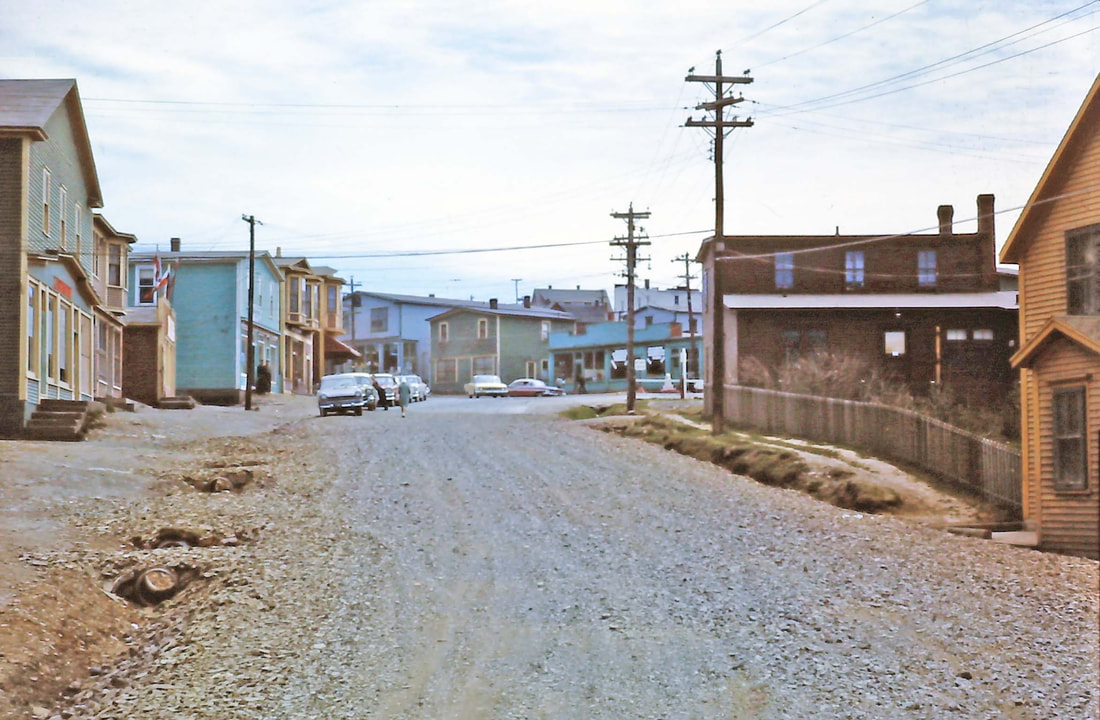
The photo below shows some of the businesses on Town Square in the early 1960s, most of which were built after the 1937 fire. The brown building on the right (next to the utility pole) was the Company Surgery, where victims of mine accidents were taken care of. That building survived the 1937 fire. Photo courtesy of A&SC, MUN Library, Coll-202, Southey slides.
1938 saw both Anglican and Roman Catholic Parishes opening new schools and enlarging others. The Avalon Telephone Company took over the telephone system from DOSCO.
In September 1939, shortly after the last shipment of Wabana ore had left for Germany on August 26th, World War II broke out. Up to that point, everything had been in full swing on Bell Island with 2,200 men employed.
As with WWI, WWII had profound consequences for Bell Island. Once again overseas markets were lost, causing slow-downs in the mines and lay-offs. Many miners found work on the American military bases in St. John’s and Argentia.
In April 1940, the mines went on half-time due to some ore carriers being engaged for military use. DOSCO advised all workers with garden allotments to plant them as they had done during the Depression.
On November 10, 1940, two small ferries collided in The Tickle, causing the deaths of 22 people, mostly commuting miners.
In 1941, D.I. (Nish) Jackman formed the Wabana Mine Workers’ Union, spurred on by the ongoing work shortage. While there had been a union of sorts for some years, this was Wabana’s first union with staying power and lasted till the mines closed in 1966. Also in 1941, Torbay Airport (forerunner of St. John’s International Airport) was constructed “to protect Bell Island from raids by German warplanes,” although it was not known to have actually played any part in deterring enemy action against shipping.
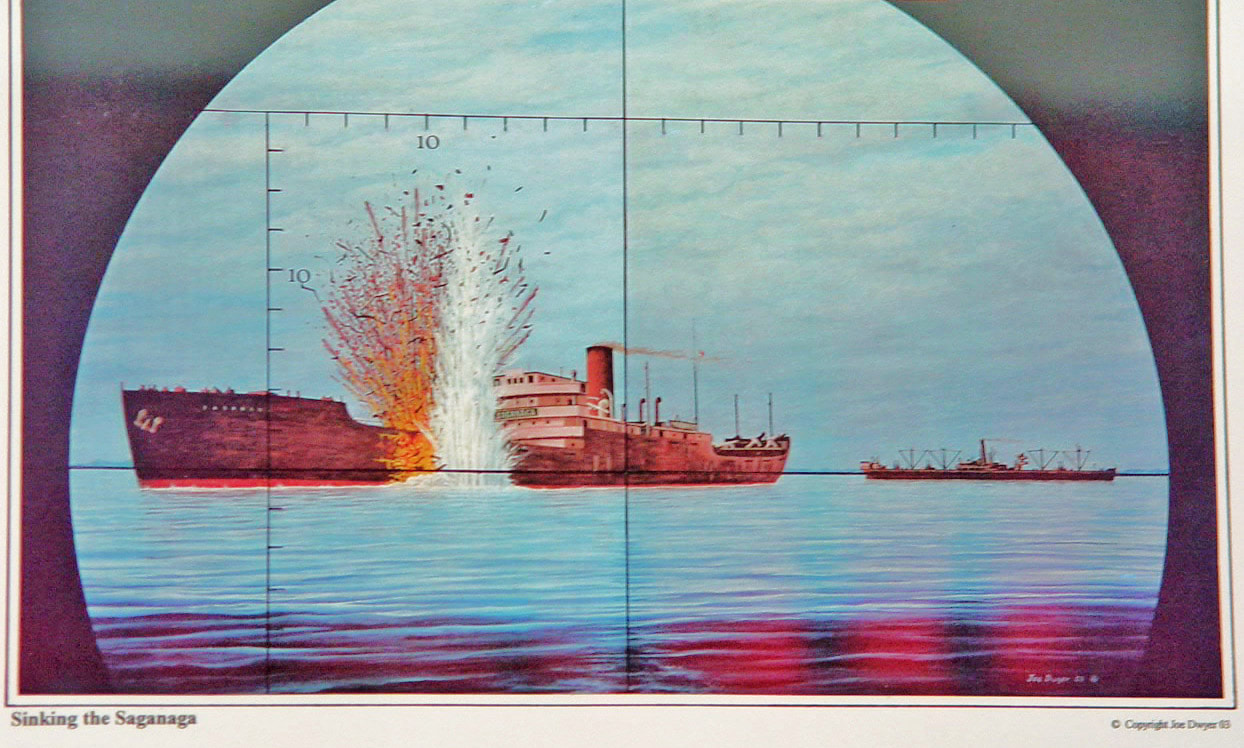
On September 5, 1942, the war came to Bell Island when a German U-boat sank 2 ore boats anchored in The Tickle, killing 29 sailors. On November 2nd, another German U-boat sank 2 more ore boats killing 36 sailors. It was said that the Germans were “throwing back what they had bought a few years before.” These German U-boats and their torpedoes were no doubt constructed of steel smelted from Wabana iron ore.
The photo below is of Joe Dwyer's painting of "Sinking the Saganaga" with the Lord Strathcona that is about to be sunk, September 5, 1942. Photo courtesy of Bell Island Community Museum.
In August 1945, World War II ended; 32 Bell Islanders had been killed. Throughout the war, the 1st Coastal Defence Battery was stationed on Bell Island, in barracks situated on Memorial Street. In November 1945, those buildings were taken over by the Boys’ Home and Training School that had recently burnt in Whitbourne. It operated on Bell Island until 1953.
In March 1946, No. 4 Mine opened for the first time in 3 years as markets began to improve.
In 1948, prosperity returned with the first shipment to Germany since the war began in 1939.
In 1949, Newfoundland became Canada’s 10th province. The Wabana iron ore deposit was touted as Newfoundland’s greatest mineral asset and one of the largest red hematite deposits in the World. In November 1949, Dominion Wabana Ore Limited, a subsidiary of DOSCO, took control of the mines.
1949-1957 was the most prosperous period in Bell Island’s mining history. That was despite the fact that in January 1950 No. 2 submarine mine ceased operating. Even with this closure, the permanent population continued to rise, reaching 10, 291 by 1951. The Town of Wabana was incorporated in 1950 and the future looked secure with 95% of the island’s workforce employed by the mining company.
From 1950-56, an extensive program to expand and modernize the mining operation was carried out. Tramways to the piers were removed in 1950 and ore cars were replaced by Euclid Trucks, which were replaced by a Trans-Island Conveyor Belt System in 1955. Machines replaced men for loading iron ore; electric locomotives replaced horses for hauling ore cars in the mines; a concentration plant replaced boys in removing rock from the iron ore. By 1956, $22 million had been spent on upgrades.
Centered in the photo below is the new infrastructure in No. 3 Mine yard after all the upgrades were made. Miners' company-built houses surround it. No. 6 Mine yard is in the left background. The right background is The Green, so named because, before mining started, it was green pasture land where livestock grazed. Photo courtesy of A&SC, MUN Library, Coll-202, Southey slides.

In 1957, A.V. Roe Canada Ltd., one of the largest companies in Canada, purchased DOSCO.
By 1958, the number employed in mining on Bell Island peaked at 2,280. That did not last long, however, as the second of the submarine mines, No. 6, was shut down in May 1959.
In 1960, ore shipments reached a zenith at 2.81 million tons and the population peaked in 1961 at 12, 281. Meanwhile, improved methods in steel-making caused Wabana’s customers to turn to Labrador and South America for higher-grade ores.
In January 1962, the third submarine mine, No. 4, shut down. Hawker Siddeley Canada Ltd. assumed the assets of A.V. Roe that year and now controlled DOSCO, eventually forcing it to close down money-losing assets, including Wabana. The final blow came for Bell Island on June 30, 1966, when the last of the submarine mines, No. 3, closed down.
Wabana was Canada’s oldest, continuously-operating iron mine when it ceased production after 71 years of activity. The total ore shipped between 1895 and 1966 was approximately 79 million tons. Almost half of this was used in Canada, while the remainder was exported to such countries as West Germany, Britain, the United States, Belgium and Holland. Despite its closure, it has been proven that ore could still be mined in accessible areas for a further twenty years at a rate of two million tons a year.
From July 1966-December 1968, skeleton staff oversaw the wrapping up of mining-related operations at Wabana. This included the fulfillment of ore sale contracts, the dismantling and sale of mining equipment and infrastructure, the bull-dozing of mine entrances, and the transference of Company house deeds to individual purchasers.