HISTORY
EDUCATION
EDUCATION
ROMAN CATHOLIC SCHOOLS
by Gail Hussey-Weir
Created April 2020 / Updated October 2025
by Gail Hussey-Weir
Created April 2020 / Updated October 2025
The photo above is of the cover of the "Souvenir of the Silver Jubilee of Rt. Rev. G.F. Bartlett, D.P, P.P., June 15, 1949."
INTRODUCTION
Records of the education of Bell Island's Roman Catholic children are vague and often without much detail. Many of the published accounts were compiled years after the fact and sometimes contradict each other.
Larry Dohey, who was the archivist at the Roman Catholic Episcopal Corporation Archives of the Roman Catholic Archdiocese of St. John's, compiled a history of St. Michael's Parish in which he stated that "a Catholic school was in operation on Bell Island as early as 1878," however, he did not say where this information originated or give any details of it. Mary Craig, in her unpublished 1983 MUN course paper, stated that, "As far as can be ascertained, the first separate Roman Catholic school was conducted by a lady in her own residence in the East End of the Island around 1875. This was the same year Bell Island got its first resident priest, Father Richard Dunphy." Craig sites an oral communication for this information, but goes on to say, "The census of 1878 indicates that the school housed forty-two students." This last statement is problematic because there does not seem to have been any census done in 1878, however, the information may have been included in a schools' report.
What follows is my attempt to pick the bones out of the various accounts to create a brief history of the Roman Catholic schools on Bell Island. I have arranged the histories of the schools in chronological order based on their inception date, or the earliest date they are believed to have existed. As always, if you have information to the contrary, anything to add, can answer any of the questions posed at the end of the page, or have questions of your own, please get in touch at [email protected].
Some of my sources for this history of Roman Catholic schools on Bell Island are:
Kathrine E. Bellamy, RSM, Weavers of the Tapestry, Flanker Press, St. John's, NL, 2006
Addison Bown, "Newspaper History of Bell Island, 1894-1939," published in The Daily News 1957-1960,
2 bound volumes, MUN QE II Library, St. John's Arts & Culture Centre Library, & Bell Island Library.
Mary Craig, "Pictoral History, Roman Catholic Schools, Bell Island, 1875-1983," unpublished course paper in
"Newfoundland School Architecture," COLL-153, A&SC, MUN Library.
Thomas A. Power, "Belle Island Boyhood: a Memoir of Newfoundland in the Nineties," Newfoundland
Quarterly, V. 85, No. 2, 1989. p. 23.
Lloyd C. Rees paper "Lance Cove, Bell Island. A Brief History of the Early Inhabitants," Nov. 23, 1972, Arts &
Culture Centre Library, St. John's, NL.
While one account says that the first mention of any school on Bell Island was a Church of England school in Lance Cove in 1869, there are records that William L. Swansborough was school master at Lance Cove around 1849-1855. [See his bio on this website on the "S" page under "People" in the top menu.]
Lloyd C. Rees wrote of the school at Lance Cove that it was "where both Roman Catholic and Church of England students attended." This was born out by Thomas A. Power, who was born on the Power farm at The Front in 1882. The farm was just east of where St. Michael's High School now stands. Power left for the United States at age 15 in 1897 and went on to become a rancher and county judge in Oregon. He published his childhood memories in 1949, in which he wrote of his schooling on Bell Island in the late 1880s into the 1890s: "Children were sent to school almost as soon as they could walk...In the winter we went to the parish school at the top of the hill and at other times we walked three miles each way to the Church of England school at Lance Cove."
Larry Dohey, who was the archivist at the Roman Catholic Episcopal Corporation Archives of the Roman Catholic Archdiocese of St. John's, compiled a history of St. Michael's Parish in which he stated that "a Catholic school was in operation on Bell Island as early as 1878," however, he did not say where this information originated or give any details of it. Mary Craig, in her unpublished 1983 MUN course paper, stated that, "As far as can be ascertained, the first separate Roman Catholic school was conducted by a lady in her own residence in the East End of the Island around 1875. This was the same year Bell Island got its first resident priest, Father Richard Dunphy." Craig sites an oral communication for this information, but goes on to say, "The census of 1878 indicates that the school housed forty-two students." This last statement is problematic because there does not seem to have been any census done in 1878, however, the information may have been included in a schools' report.
What follows is my attempt to pick the bones out of the various accounts to create a brief history of the Roman Catholic schools on Bell Island. I have arranged the histories of the schools in chronological order based on their inception date, or the earliest date they are believed to have existed. As always, if you have information to the contrary, anything to add, can answer any of the questions posed at the end of the page, or have questions of your own, please get in touch at [email protected].
Some of my sources for this history of Roman Catholic schools on Bell Island are:
Kathrine E. Bellamy, RSM, Weavers of the Tapestry, Flanker Press, St. John's, NL, 2006
Addison Bown, "Newspaper History of Bell Island, 1894-1939," published in The Daily News 1957-1960,
2 bound volumes, MUN QE II Library, St. John's Arts & Culture Centre Library, & Bell Island Library.
Mary Craig, "Pictoral History, Roman Catholic Schools, Bell Island, 1875-1983," unpublished course paper in
"Newfoundland School Architecture," COLL-153, A&SC, MUN Library.
Thomas A. Power, "Belle Island Boyhood: a Memoir of Newfoundland in the Nineties," Newfoundland
Quarterly, V. 85, No. 2, 1989. p. 23.
Lloyd C. Rees paper "Lance Cove, Bell Island. A Brief History of the Early Inhabitants," Nov. 23, 1972, Arts &
Culture Centre Library, St. John's, NL.
While one account says that the first mention of any school on Bell Island was a Church of England school in Lance Cove in 1869, there are records that William L. Swansborough was school master at Lance Cove around 1849-1855. [See his bio on this website on the "S" page under "People" in the top menu.]
Lloyd C. Rees wrote of the school at Lance Cove that it was "where both Roman Catholic and Church of England students attended." This was born out by Thomas A. Power, who was born on the Power farm at The Front in 1882. The farm was just east of where St. Michael's High School now stands. Power left for the United States at age 15 in 1897 and went on to become a rancher and county judge in Oregon. He published his childhood memories in 1949, in which he wrote of his schooling on Bell Island in the late 1880s into the 1890s: "Children were sent to school almost as soon as they could walk...In the winter we went to the parish school at the top of the hill and at other times we walked three miles each way to the Church of England school at Lance Cove."
The Parish (of St. Michael) School "at the top of the hill," Court House Hill
c.1880s - 1902
c.1880s - 1902
When Thomas Power says in his memoir, "the parish school at the top of the hill," he may have been referring to the precursor of the Roman Catholic Superior School that opened in 1902, which was at the top of what would become known as Court House Hill in the early 1900s after Bell Island's first court house was built there. A mention in The Daily News in 1938 (Bown, 1938, p. 71) says that by 1896, there were two Roman Catholic schools, one of which was on what became known as Court House Hill. A newspaper report from 1900, states that, "The new court house and constable's residence were being erected in September on a road at the Front which has been known ever since as Court House Hill. On September 13, 1900, the first Magistrate's Court Session was held on Bell Island by Dr. Freebairn, J.P., in the Roman Catholic Schoolhouse. (Bown, 1900, p. 14) Since construction of the Superior School did not start until the summer of 1901, this leads me to believe that the new Superior School that opened there in 1902 was in the location of what had already been a Roman Catholic school for over 20 years. The other Roman Catholic school in operation "by 1896" was in Lance Cove, built under the auspices of Father Patrick O'Brien, who was parish priest from 1892-1896. Meanwhile, in the 1891 Census, the two schools (Anglican at Lance Cove and R.C. at the Front) between them had 164 children in attendance.
So, assuming that the Roman Catholic Superior School on Court House Hill was an update of a former (and perhaps the first dedicated) RC school building on Bell Island, here is the information I have on the Superior School.
Superior (High) School, Court House Hill, 1902 - c.1917
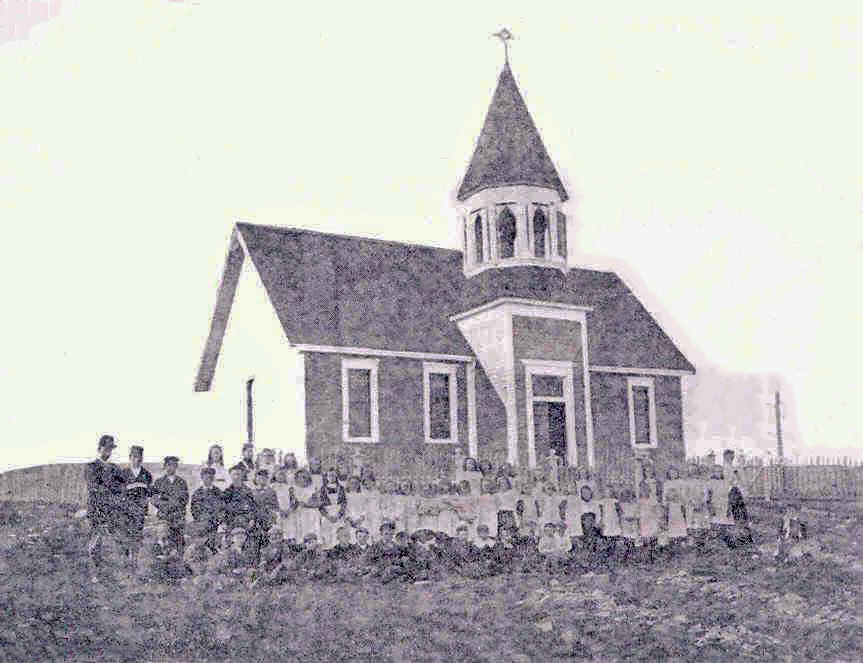
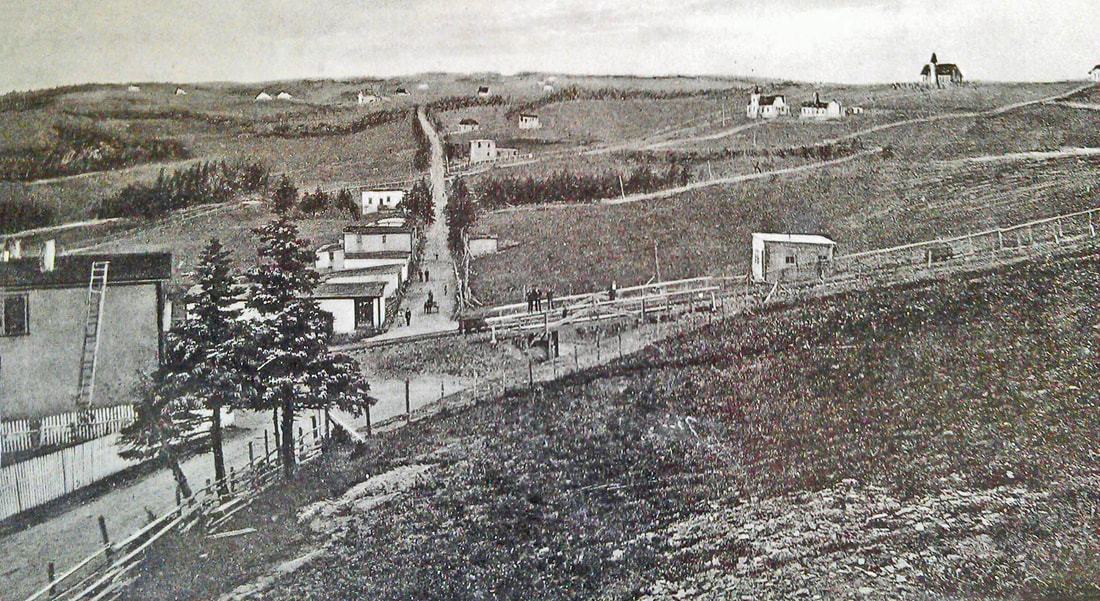
The photo above is from about 1902. In the painting(?) below, the road running vertically through the center is Old Front Road (now called Nish Jackman Drive). Branching off it towards the upper right hand corner is Court House Hill. I believe the building with the bell tower at the top on the horizon is the R.C. Superior School. The two buildings downhill from it are the Court House on the left and the Constable's House on the right. Photo courtesy of Ray Rees.
Bell Island's first high school was under construction in July 1901 (Bown, 1901, p. 15) and was being built under the direction of Bell Island's first School Board, which had been appointed on May 31, 1898, and whose members included Rev. J.J. McGrath, Michael Dwyer, Thomas Fitzgerald, Patrick Brown and William Stoyles. (Bown, 1898, p. 7)
Here is a description of the building from the Evening Telegram newspaper in an article entitled "Two New School Houses Building at Bell Island":
"High School: The High School commands a splendid view...is 30 by 60 with an Octagon tower, rising from the centre to the height of 60 feet, surmounted by a Celtic cross...The school is built to accommodate both sexes, a division made of two large panel doors to elevate in the ceiling, the largest ever made by the Horwood Lumber Company...The building is one of the finest in Newfoundland. The furniture and apparatus are of a high-class description: the desks are single and double 'Orion' from Philadelphia, U.S.A. The plans and specifications were prepared by W.F. Butler, architect; the workmanship is done in good workmanlike manner, superintended by Ed. Doran, St. John's." (Evening Telegram, Sept. 24, 1901, p. 3)
The school, located at the top of Court House Hill, opened on February 17, 1902 (Bown, 1902, p. 15). The high school syllabus included a commercial course and the school was Bell Island's first centre for C.H.E. exams. The school had 75 pupils in 1914 according to the "Report of the Public Schools of Newfoundland under R.C. Boards, 1914." (Craig, p. 7) This high school seems to have ceased operation shortly after the Sisters of Mercy arrived to begin teaching on Bell Island in September 1917. On Monday the 24th, 1917, Archbishop Roche celebrated mass at St. Michael's Church [located where the present-day St. Michael's Regional High School now stands] in honour of the arrival of the Sisters. "After mass, the congregation, clergy, parents and school children accompanied the Sisters in procession to the school [on Court House Hill] where the archbishop blessed the former Superior School, renamed St. Edward's Convent School in honour of the archbishop's patron saint... Because [this former Superior School, now renamed to] St. Edward's School was so far away from the convent [which was immediately east of St. Michael's Church], Father McGrath decided that they should teach in St. Joseph's Hall [which was immediately to the west of St. Michael's Church] for the time being." [Source: Annals of St. Edward's Convent, Bell Island, as reported by Sister Kathrine E. Bellamy, RSM, in Weavers of the Tapestry, p. 337.]
So, technically, for a short period of time after September 1917, the Superior School building was the first St. Edward's Convent School until its distance from the convent necessitated St. Edward's School being relocated to St. Joseph's Hall. [See more on the history of St. Edward's further down the page.]
When the Island's first Catholic Cadet Corps formed on November 5, 1913, it was located in the Roman Catholic Superior (High) School on Court House Hill and flourished for 10 years before disbanding. [Source: Bown, 1913, p. 43.]
The building was destroyed by fire on July 13, 1930. J.C. Cramm built a garage on the site shortly after the fire. (Bown, 1930, p. 32)
Here is a description of the building from the Evening Telegram newspaper in an article entitled "Two New School Houses Building at Bell Island":
"High School: The High School commands a splendid view...is 30 by 60 with an Octagon tower, rising from the centre to the height of 60 feet, surmounted by a Celtic cross...The school is built to accommodate both sexes, a division made of two large panel doors to elevate in the ceiling, the largest ever made by the Horwood Lumber Company...The building is one of the finest in Newfoundland. The furniture and apparatus are of a high-class description: the desks are single and double 'Orion' from Philadelphia, U.S.A. The plans and specifications were prepared by W.F. Butler, architect; the workmanship is done in good workmanlike manner, superintended by Ed. Doran, St. John's." (Evening Telegram, Sept. 24, 1901, p. 3)
The school, located at the top of Court House Hill, opened on February 17, 1902 (Bown, 1902, p. 15). The high school syllabus included a commercial course and the school was Bell Island's first centre for C.H.E. exams. The school had 75 pupils in 1914 according to the "Report of the Public Schools of Newfoundland under R.C. Boards, 1914." (Craig, p. 7) This high school seems to have ceased operation shortly after the Sisters of Mercy arrived to begin teaching on Bell Island in September 1917. On Monday the 24th, 1917, Archbishop Roche celebrated mass at St. Michael's Church [located where the present-day St. Michael's Regional High School now stands] in honour of the arrival of the Sisters. "After mass, the congregation, clergy, parents and school children accompanied the Sisters in procession to the school [on Court House Hill] where the archbishop blessed the former Superior School, renamed St. Edward's Convent School in honour of the archbishop's patron saint... Because [this former Superior School, now renamed to] St. Edward's School was so far away from the convent [which was immediately east of St. Michael's Church], Father McGrath decided that they should teach in St. Joseph's Hall [which was immediately to the west of St. Michael's Church] for the time being." [Source: Annals of St. Edward's Convent, Bell Island, as reported by Sister Kathrine E. Bellamy, RSM, in Weavers of the Tapestry, p. 337.]
So, technically, for a short period of time after September 1917, the Superior School building was the first St. Edward's Convent School until its distance from the convent necessitated St. Edward's School being relocated to St. Joseph's Hall. [See more on the history of St. Edward's further down the page.]
When the Island's first Catholic Cadet Corps formed on November 5, 1913, it was located in the Roman Catholic Superior (High) School on Court House Hill and flourished for 10 years before disbanding. [Source: Bown, 1913, p. 43.]
The building was destroyed by fire on July 13, 1930. J.C. Cramm built a garage on the site shortly after the fire. (Bown, 1930, p. 32)
Sacred Heart School, Lance Cove, 1896-1969
The second Roman Catholic school that Addison Bown wrote about in 1938 as having been in operation on Bell Island by 1896 was in Lance Cove. Of it, he said, "When Father McGrath came to Bell Island in 1896, the Parish of St. Michael's consisted of a small church at the Front, a presbytery nearby, a hall and school at the Front, and a school at Lance Cove, just completed by Fr. O'Brien." (Bown, 1938, p. 71) I do not know if this early version of the Lance Cove school was actually called Sacred Heart as references to it are scarce and simply refer to it as "the R.C. School at Lance Cove." The photo above is of Lance Cove c.1920s. If you can pinpoint the R.C. school, please get in touch at [email protected].
The picture below is presumably of the 1948 school as it appears on the cover of the "Souvenir of the Silver Jubilee of Rt. Rev. G.F. Bartlett, D.P, P.P., June 15, 1949."
The Roman Catholic School in Lance Cove existed in at least three periods of time: 1896-1926; 1926-1948; 1948-c.1969, and may have been in two (or three?) different locations.
Following are some references that I found to the R.C. school in Lance Cove:
On Tuesday, August 16, 1897, a visitor to Bell Island as a guest of Father McGrath "took a walk to Lance Cove and attended a concert in aid of the new school." (Bown, 1897, p. 7)
There were 50 pupils at the Lance Cove School in 1914 according to the "Report of the Public Schools of Newfoundland under R.C. Boards, 1914." (Craig, p. 7)
In 1918, the first world war was still raging. Women's Patriotic Associations everywhere, including Bell Island, were meeting regularly to prepare care packages to send overseas to their local boys who were deployed there. The local W.P.A. report noted that the ladies were using schools around the Island as work centres, including the R.C. schools at the East End and Lance Cove. (Bown, 1918, p. 56)
In 1923, "The foundation of a new R.C. school at Lance Cove was laid at the beginning of November." (Bown, 1923, p. 73)
In the summer of 1926, "The Mount Cashel Band, which was present for the garden party, gave an open-air dance on the floor of the new R.C. school then under construction at Lance Cove. When the school was completed in October, a dinner and dance were held under the auspices of the A.A.A. (Amateur Athletic Association of Newfoundland) in honour of the players in the divisional football series. Speakers at the banquet were Rev. E.J. Rawlins, C. Main, M.J. O'Neill, Jas. Connors, R.R. Costigan, A. Bown and P.T. Murphy." In September 1927, when the new St. Cecilia's School in West Mines was nearing completion, it was said of it, "It is a fine building, much on the style of the Convent School, Wabana, and the R.C. School at Lance Cove." [See the image of the first Immaculate Conception School further down this page for an idea of the architecture of this school.] Interestingly, the Mount Cashel Band also performed at a dance in St. Cecelia's School just before it opened.
In January 1928, the mining company appointed a committee to set up night schools for its employees. One of these was opened at Lance Cove on February 23rd with the principal, Florence O'Neil, of the R.C. school in charge. (Bown, 1928, p. 21)
"For a play staged at the R.C. school in Lance Cove on February 1st, 1928, the road had to be shovelled to let cars through from the Front and the Mines." This snow shovelling would have been done by hand as there were no snow plows on Bell Island at that time. "Electric light was first used in Lance Cove for that performance, generated by a set of batteries in the school." Lance Cove did not get electric lines until September 25, 1930. (Other areas of the Island had gotten electricity in December 1928.) The switch was thrown by Lance Cove's oldest resident, Reuben Rees, in a ceremony at the Roman Catholic School. (Bown, 1928, p. 22)
On the morning of June 28, 1938, Very Rev. James J. McGrath, parish priest of Bell Island and Dean of the Archdiocese of St. John's, died in St. Clare's Mercy Hospital at the age of 76. He had been appointed parish priest of Bell Island in November 1896, succeeding Rev. Patrick O'Brien. Father McGrath had been ordained in 1889 and, at the time of his death in 1938, a special building programme was being undertaken to commemorate his upcoming Golden Jubilee in 1939. "In addition to the completion and opening of the Church of St. James, schools for boys were being built at both the Front and Mines, and a new school at the East End, all of which were completed that summer. The schools at Lance Cove and West Mines were also enlarged." (Daily News, Dec. 31, 1938; Bown 1938, p. 71)
From The Daily News, Dec. 31, 1948, p. 83:
"The new Sacred Heart school at Lance Cove, erected in 1947, was completed this year. The building is 106 feet long and 39 feet wide and contains four classrooms. The new school cost $50,000 to complete. It was opened in September at the beginning of the new school year with an extra teacher added to the staff." Saunders, Howell & Co. had the contract for this school. (Daily News, Dec. 31, 1948, p. 83)
In 1953, "Sacred Heart School at Lance Cove received an extension of two rooms. (Craig, p. 13)
In September 1969, the R.C. schools on the Island were completely reorganized by the School Board as a result of the decline in pupil population that followed the shutdown of the Wabana Mines in 1966. According to Craig (p. 16), "all schools were closed with the exception of St. Edward's, St. Kevin's and the Immaculate Conception."
Following are some references that I found to the R.C. school in Lance Cove:
On Tuesday, August 16, 1897, a visitor to Bell Island as a guest of Father McGrath "took a walk to Lance Cove and attended a concert in aid of the new school." (Bown, 1897, p. 7)
There were 50 pupils at the Lance Cove School in 1914 according to the "Report of the Public Schools of Newfoundland under R.C. Boards, 1914." (Craig, p. 7)
In 1918, the first world war was still raging. Women's Patriotic Associations everywhere, including Bell Island, were meeting regularly to prepare care packages to send overseas to their local boys who were deployed there. The local W.P.A. report noted that the ladies were using schools around the Island as work centres, including the R.C. schools at the East End and Lance Cove. (Bown, 1918, p. 56)
In 1923, "The foundation of a new R.C. school at Lance Cove was laid at the beginning of November." (Bown, 1923, p. 73)
In the summer of 1926, "The Mount Cashel Band, which was present for the garden party, gave an open-air dance on the floor of the new R.C. school then under construction at Lance Cove. When the school was completed in October, a dinner and dance were held under the auspices of the A.A.A. (Amateur Athletic Association of Newfoundland) in honour of the players in the divisional football series. Speakers at the banquet were Rev. E.J. Rawlins, C. Main, M.J. O'Neill, Jas. Connors, R.R. Costigan, A. Bown and P.T. Murphy." In September 1927, when the new St. Cecilia's School in West Mines was nearing completion, it was said of it, "It is a fine building, much on the style of the Convent School, Wabana, and the R.C. School at Lance Cove." [See the image of the first Immaculate Conception School further down this page for an idea of the architecture of this school.] Interestingly, the Mount Cashel Band also performed at a dance in St. Cecelia's School just before it opened.
In January 1928, the mining company appointed a committee to set up night schools for its employees. One of these was opened at Lance Cove on February 23rd with the principal, Florence O'Neil, of the R.C. school in charge. (Bown, 1928, p. 21)
"For a play staged at the R.C. school in Lance Cove on February 1st, 1928, the road had to be shovelled to let cars through from the Front and the Mines." This snow shovelling would have been done by hand as there were no snow plows on Bell Island at that time. "Electric light was first used in Lance Cove for that performance, generated by a set of batteries in the school." Lance Cove did not get electric lines until September 25, 1930. (Other areas of the Island had gotten electricity in December 1928.) The switch was thrown by Lance Cove's oldest resident, Reuben Rees, in a ceremony at the Roman Catholic School. (Bown, 1928, p. 22)
On the morning of June 28, 1938, Very Rev. James J. McGrath, parish priest of Bell Island and Dean of the Archdiocese of St. John's, died in St. Clare's Mercy Hospital at the age of 76. He had been appointed parish priest of Bell Island in November 1896, succeeding Rev. Patrick O'Brien. Father McGrath had been ordained in 1889 and, at the time of his death in 1938, a special building programme was being undertaken to commemorate his upcoming Golden Jubilee in 1939. "In addition to the completion and opening of the Church of St. James, schools for boys were being built at both the Front and Mines, and a new school at the East End, all of which were completed that summer. The schools at Lance Cove and West Mines were also enlarged." (Daily News, Dec. 31, 1938; Bown 1938, p. 71)
From The Daily News, Dec. 31, 1948, p. 83:
"The new Sacred Heart school at Lance Cove, erected in 1947, was completed this year. The building is 106 feet long and 39 feet wide and contains four classrooms. The new school cost $50,000 to complete. It was opened in September at the beginning of the new school year with an extra teacher added to the staff." Saunders, Howell & Co. had the contract for this school. (Daily News, Dec. 31, 1948, p. 83)
In 1953, "Sacred Heart School at Lance Cove received an extension of two rooms. (Craig, p. 13)
In September 1969, the R.C. schools on the Island were completely reorganized by the School Board as a result of the decline in pupil population that followed the shutdown of the Wabana Mines in 1966. According to Craig (p. 16), "all schools were closed with the exception of St. Edward's, St. Kevin's and the Immaculate Conception."
|
To view extra photos of Sacred Heart School, click the button on the right>>>
|
St. Peter's School, Theatre Avenue, aka "The Mines School," 1901-1920
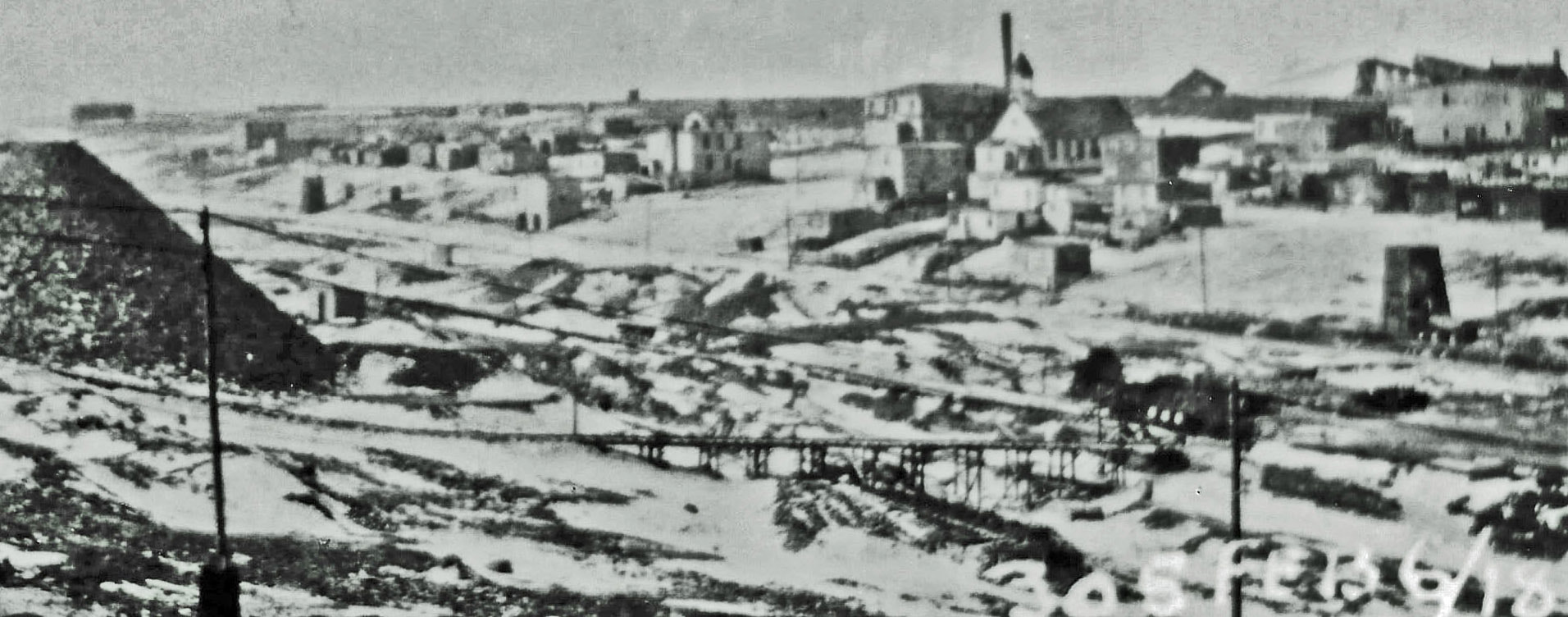
The photo above shows the western section of the Green in February 1918. Just to the right of middle on the horizon, you can see the St. Peter's RC Hall that held the Gaiety Theatre [hence the name "Theatre Avenue"] with St. Peter's RC School/Church immediately east of it. The building was no longer used as a school after 1920 when Immaculate Conception Convent School opened on Town Square to accommodate the growing population of Roman Catholic children in the Mines area. It did continue to be used as a church, however, until St. James Church opened on Town Square in 1938. The photo was taken by Alphonsus Lawton, brother of druggist Louis Lawton, and is courtesy of MUN A&SC.
For some time, I had assumed that the building on The Green with the tall bell tower was St. Peter's Church and not the original St. Peter's School. Whenever pictures of St. Peter's Hall and the building to the east of it were discussed, it was only ever referred to as the RC Hall and Church, both called St. Peter's. It certainly resembled a typical church of the era. Its reference only as a church may also be because it ceased being a school in 1920, over 100 years ago, so the school was not part of the collective memory for people of my parents' or my generations. When I was sent the following 1901 Evening Telegram newspaper clipping with a detailed description of "Two New School Houses Building at Bell Island," it became clear that this building had originally been built as a school, tall belfry and all. Here are the main features as described in the article:
"School at the Mines: A design well adapted for execution in villages and country towns, and which may be used either as a schoolhouse or chapel. It has one room for the accommodation of pupils...The building is 26 by 48, with an additional cloak room, and a vestibule forms the entrance...It is 31 feet high to point of roof, with a belfry 56 feet high, surmounted by a Celtic cross which is 6 feet high. The belfry is finished in opened circular work, with a sweep at the base, which gives a beautiful appearance...the belfry roof being covered with tin and given three coats of paint in terra cotta, with cream trimmings...The chimney is built on the outside...An interesting feature is the provision for lighting the room, it being that the windows are all at one side and on the rear, while the wall, which is at the right of the pupils as they face the platform, is blank. The school was designed by Frank C. Miller, U.S.A., and the builder is E. Doran, St. John's." (Evening Telegram, Sept. 24, 1901, p. 3)
In the photo below left of St. Peter's Hall and Church, features described above such as the chimney on the outside, the wall with no windows and the belfry can be plainly seen. Likewise, in the photo on the right, it can be seen that the east wall is all windows.
For some time, I had assumed that the building on The Green with the tall bell tower was St. Peter's Church and not the original St. Peter's School. Whenever pictures of St. Peter's Hall and the building to the east of it were discussed, it was only ever referred to as the RC Hall and Church, both called St. Peter's. It certainly resembled a typical church of the era. Its reference only as a church may also be because it ceased being a school in 1920, over 100 years ago, so the school was not part of the collective memory for people of my parents' or my generations. When I was sent the following 1901 Evening Telegram newspaper clipping with a detailed description of "Two New School Houses Building at Bell Island," it became clear that this building had originally been built as a school, tall belfry and all. Here are the main features as described in the article:
"School at the Mines: A design well adapted for execution in villages and country towns, and which may be used either as a schoolhouse or chapel. It has one room for the accommodation of pupils...The building is 26 by 48, with an additional cloak room, and a vestibule forms the entrance...It is 31 feet high to point of roof, with a belfry 56 feet high, surmounted by a Celtic cross which is 6 feet high. The belfry is finished in opened circular work, with a sweep at the base, which gives a beautiful appearance...the belfry roof being covered with tin and given three coats of paint in terra cotta, with cream trimmings...The chimney is built on the outside...An interesting feature is the provision for lighting the room, it being that the windows are all at one side and on the rear, while the wall, which is at the right of the pupils as they face the platform, is blank. The school was designed by Frank C. Miller, U.S.A., and the builder is E. Doran, St. John's." (Evening Telegram, Sept. 24, 1901, p. 3)
In the photo below left of St. Peter's Hall and Church, features described above such as the chimney on the outside, the wall with no windows and the belfry can be plainly seen. Likewise, in the photo on the right, it can be seen that the east wall is all windows.
|
The photo on the right is from the October 1913 issue of Newfoundland Quarterly, p. 5, in an article by Archbishop Michael Francis Howley. The caption beneath the photo said, "His Grace the Archbishop at the Schoolhouse at Wabana, Bell Island." The building seen to the west of the school is St. Peter's RC Hall, home of the Gaiety Theatre.
|
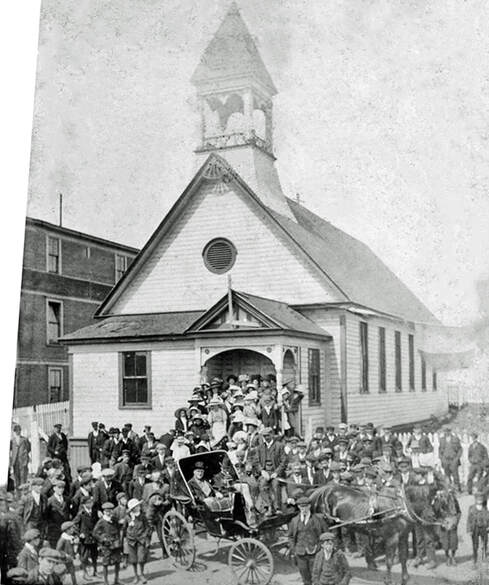
Following are some brief mentions of it, but not much specific information, from the Daily News (Bown), Sister Bellamy and Mary Craig:
Bown: 1902, p. 16: "On the occasion of the opening of Bell Island's first 'high' school, which was located on Court House Hill, February 17, 1902, it was reported that, in his speech, the Superintendent of R.C. schools, Vincent P. Burke, complimented the people of Bell Island on their High School and also their school at the Mines.” [This indicates that St. Peter's School opened prior to 1902. St. Peter's Church Hall was built on the Green six years later in 1908; a year after that St. Peter's RC Church was reported to have "opened." A search of Daily News articles about Bell Island in 1909 turned up no mention of a church being built on The Green, and when St. Peter's Church "opened," there was nothing to indicate that this was a special accomplishment, no celebrations surrounding it, no visit from the Archbishop to lay the cornerstone or to bless the church, etc.
This leads me to believe that St. Peter's Church was actually not a new, separate building but, instead, a secondary use for the school house until it became its primary function after 1920 and until 1938. Unfortunately, none of these articles spell this out.]
Craig, p. 7: "By 1914, the Roman Catholic system had four schools located in various parts of the Island. The Superior School at the Front housed 75 pupils; Lance Cove school accommodated 50 pupils; the East End school had a population of 53 pupils; and the Mines school had 68 pupils." Regarding "the Mines school," she added in brackets "as far as can be ascertained, this school was St. Peter's on the Green," so it seems that she did not have much luck in getting information on that school either.
Bown: 1915, p. 48: "In March 1915, the R.C. parishioners at the Mines formed a Parish Committee to raise funds for the building of a school as the existing building [St. Peter's] was too small."
Bellamy: 1919, p. 340-341: Shortly after the Sisters of Mercy began teaching at the Front, children from other parts of Bell Island began attending their school. "This meant a long walk for many children from the section of Bell Island called 'the Mines.' After a year or two of greeting small children who were tired out after such a long walk, the sisters questioned why they did not go to the students rather than have the students come to them...Beginning in 1919, in addition to teaching at the Front, the sisters took over the direction of the school at the Mines. Every day of the school year, two of the sisters travelled by horse and carriage across the 'Track,' from the convent to the Mines school." Travelling back and forth in an open carriage on the ore car tracks with "frequent exposure to rain, snow, sleet, and high winds, not to mention the effects of frequent immersion up to the neck in banks of snow" [no mention was made of the danger of riding on the ore car tracks, if that was what they were doing; perhaps they were riding alongside the track, which would still be a dangerous thing to do.] led the Mother Superior to suggest that the parish hire lay teachers who lived closer to the school during the winter months. "In fact, the Mines school had become too small to accommodate all the Catholic children of that section of Bell Island" so Father McGrath decided to build a new school at the Mines [which would be called Immaculate Conception]. Interestingly, Sister Kathrine did not refer to the school by the name "St. Peter's," nor did she mention St. Peter's Church or Church Hall on the Green, perhaps because they had both been in operation before the Sisters of Mercy arrived on Bell Island. Instead, she only makes reference to "the school at the Mines."
Bown: 1919, p. 59: “A project was launched on June 15, 1919, to build a Convent school at the Mines” [Immaculate Conception was opened Sept. 24, 1920, on Town Square, to replace the school on the Green].
Bown: 1930, p. 32: An article in the Daily News about the history of Rev. J.J. McGrath, Parish Priest on Bell Island, says that the first school built under his auspices was the high school on Court House Hill, "then came St. Peter's School on the Green." The reverse seems to be true, however, as seen in the 1902 item above in which Vincent Burke mentioned the school at the Mines in his speech at the opening of the High School. [The 1930 article was the only one I could find that actually gives a name to that early "school at the Mines."]
It is believed that the church that had been St. Peter's School originally, along with St. Peter's Hall on Theatre Avenue, burned to the ground sometime in the late 1940s.
Bown: 1902, p. 16: "On the occasion of the opening of Bell Island's first 'high' school, which was located on Court House Hill, February 17, 1902, it was reported that, in his speech, the Superintendent of R.C. schools, Vincent P. Burke, complimented the people of Bell Island on their High School and also their school at the Mines.” [This indicates that St. Peter's School opened prior to 1902. St. Peter's Church Hall was built on the Green six years later in 1908; a year after that St. Peter's RC Church was reported to have "opened." A search of Daily News articles about Bell Island in 1909 turned up no mention of a church being built on The Green, and when St. Peter's Church "opened," there was nothing to indicate that this was a special accomplishment, no celebrations surrounding it, no visit from the Archbishop to lay the cornerstone or to bless the church, etc.
This leads me to believe that St. Peter's Church was actually not a new, separate building but, instead, a secondary use for the school house until it became its primary function after 1920 and until 1938. Unfortunately, none of these articles spell this out.]
Craig, p. 7: "By 1914, the Roman Catholic system had four schools located in various parts of the Island. The Superior School at the Front housed 75 pupils; Lance Cove school accommodated 50 pupils; the East End school had a population of 53 pupils; and the Mines school had 68 pupils." Regarding "the Mines school," she added in brackets "as far as can be ascertained, this school was St. Peter's on the Green," so it seems that she did not have much luck in getting information on that school either.
Bown: 1915, p. 48: "In March 1915, the R.C. parishioners at the Mines formed a Parish Committee to raise funds for the building of a school as the existing building [St. Peter's] was too small."
Bellamy: 1919, p. 340-341: Shortly after the Sisters of Mercy began teaching at the Front, children from other parts of Bell Island began attending their school. "This meant a long walk for many children from the section of Bell Island called 'the Mines.' After a year or two of greeting small children who were tired out after such a long walk, the sisters questioned why they did not go to the students rather than have the students come to them...Beginning in 1919, in addition to teaching at the Front, the sisters took over the direction of the school at the Mines. Every day of the school year, two of the sisters travelled by horse and carriage across the 'Track,' from the convent to the Mines school." Travelling back and forth in an open carriage on the ore car tracks with "frequent exposure to rain, snow, sleet, and high winds, not to mention the effects of frequent immersion up to the neck in banks of snow" [no mention was made of the danger of riding on the ore car tracks, if that was what they were doing; perhaps they were riding alongside the track, which would still be a dangerous thing to do.] led the Mother Superior to suggest that the parish hire lay teachers who lived closer to the school during the winter months. "In fact, the Mines school had become too small to accommodate all the Catholic children of that section of Bell Island" so Father McGrath decided to build a new school at the Mines [which would be called Immaculate Conception]. Interestingly, Sister Kathrine did not refer to the school by the name "St. Peter's," nor did she mention St. Peter's Church or Church Hall on the Green, perhaps because they had both been in operation before the Sisters of Mercy arrived on Bell Island. Instead, she only makes reference to "the school at the Mines."
Bown: 1919, p. 59: “A project was launched on June 15, 1919, to build a Convent school at the Mines” [Immaculate Conception was opened Sept. 24, 1920, on Town Square, to replace the school on the Green].
Bown: 1930, p. 32: An article in the Daily News about the history of Rev. J.J. McGrath, Parish Priest on Bell Island, says that the first school built under his auspices was the high school on Court House Hill, "then came St. Peter's School on the Green." The reverse seems to be true, however, as seen in the 1902 item above in which Vincent Burke mentioned the school at the Mines in his speech at the opening of the High School. [The 1930 article was the only one I could find that actually gives a name to that early "school at the Mines."]
It is believed that the church that had been St. Peter's School originally, along with St. Peter's Hall on Theatre Avenue, burned to the ground sometime in the late 1940s.
St. Theresa's School, Lighthouse Road, aka "East End School," c.1914-1967
When Father McGrath celebrated his Jubilee Year on July 28, 1914, the address to him noted that, "On assuming charge of the Parish, there was but one school [presumably referring to the Parish School on Court House Hill but forgetting about the school in Lance Cove?]. Today [1914] the educational facilities consist of a High School and four Primaries." (Daily News, July 31, 1914, p. 6) These primary schools were not named but probably included the East End school, as the "Report of the Public Schools of Newfoundland under R.C. Boards, 1914" reported that year that "the East End school had a population of 53 pupils."
I did not find any specific newspaper reference as to when St. Theresa's School first opened. The first mention I found of it in the news was in 1918 when the first world war was still raging. Women's Patriotic Associations everywhere, including Bell Island, were meeting regularly to prepare care packages to send overseas to their local boys who were deployed there. The local W.P.A. report noted that the ladies were using schools around the Island as work centres, including the R.C. schools at the East End and Lance Cove. (Bown, 1918, p. 56)
The next newspaper mention I found was in September 1928 in a list of "changes among local teachers," in which it was noted that "Marion Fitzgerald once more directs the R.C. School, East End." (Bown, 1928, p. 25)
As with some of the other schools, very little specific information was found about St. Theresa's, but when commentators wrote of the legacy of Father McGrath following his death in 1938, it was said that the special building programme that was undertaken to commemorate his Golden Jubilee included the building of three new schools, one of which was "at the East End." (Daily News, Dec. 31, 1938; Bown 1938, p. 71)
In a comment on a Facebook post regarding R.C. Schools, a former student of St. Theresa's School said, "I attended St. Theresa's School back in the 40s when it was a one-room school with one teacher...that one teacher taught Primer and Grades 1 to 4." (Bill O'Leary in "If You Grew Up On Bell Island..." Facebook Group, 2019) Another former student said that, "another classroom was built on and Grades 1 and 2 moved to the new room after Christmas 1949." (Agnes M. Ford in "If You Grew Up On Bell Island..." Facebook Group, 2015) Another former student who attended after the school had been extended to a two-room school said, "When I attended St. Theresa's School, from 1955-1960, it had two rooms, Grades 1 and 2 in one room and 3, 4 and 5 in the other. I certainly remember the pot belly stoves!" (Rosalind Hurley in "If You Grew Up On Bell Island..." Facebook Group, 2019)
The photo above from the cover of the "Souvenir of the Silver Jubilee of Rt. Rev. G.F. Bartlett, D.P, P.P., June 15, 1949," presumably shows the school after it was expanded in 1948, as described in The Daily News, Dec. 31, 1948, p. 83:
"The growing number of children of school age made it necessary during the year to double the size of the school at the East End. This was originally designed for a capacity of 42 children. Today it has 80 pupils, necessitating the services of an extra teacher."
Mary Craig, in her 1983 paper on the architecture of Bell Island's Roman Catholic schools, said that St. Theresa's at the East End was extended from a two-room school to six rooms and that this extension took place in two different phases, but no dates for those extensions were given. (Craig, p. 13) It must have been in the early 1960s according to the comments above from people who attended the school.
From a comment made by another former student, it seems that the school closed following the 1966-67 school year. (Bob Stone in "If You Grew Up On Bell Island..." Facebook Group, 2013)
The building was demolished in 1969. (Jack Jardine, who worked on the demolition, in "If You Grew Up On Bell Island..." Facebook Group, 2019)
I did not find any specific newspaper reference as to when St. Theresa's School first opened. The first mention I found of it in the news was in 1918 when the first world war was still raging. Women's Patriotic Associations everywhere, including Bell Island, were meeting regularly to prepare care packages to send overseas to their local boys who were deployed there. The local W.P.A. report noted that the ladies were using schools around the Island as work centres, including the R.C. schools at the East End and Lance Cove. (Bown, 1918, p. 56)
The next newspaper mention I found was in September 1928 in a list of "changes among local teachers," in which it was noted that "Marion Fitzgerald once more directs the R.C. School, East End." (Bown, 1928, p. 25)
As with some of the other schools, very little specific information was found about St. Theresa's, but when commentators wrote of the legacy of Father McGrath following his death in 1938, it was said that the special building programme that was undertaken to commemorate his Golden Jubilee included the building of three new schools, one of which was "at the East End." (Daily News, Dec. 31, 1938; Bown 1938, p. 71)
In a comment on a Facebook post regarding R.C. Schools, a former student of St. Theresa's School said, "I attended St. Theresa's School back in the 40s when it was a one-room school with one teacher...that one teacher taught Primer and Grades 1 to 4." (Bill O'Leary in "If You Grew Up On Bell Island..." Facebook Group, 2019) Another former student said that, "another classroom was built on and Grades 1 and 2 moved to the new room after Christmas 1949." (Agnes M. Ford in "If You Grew Up On Bell Island..." Facebook Group, 2015) Another former student who attended after the school had been extended to a two-room school said, "When I attended St. Theresa's School, from 1955-1960, it had two rooms, Grades 1 and 2 in one room and 3, 4 and 5 in the other. I certainly remember the pot belly stoves!" (Rosalind Hurley in "If You Grew Up On Bell Island..." Facebook Group, 2019)
The photo above from the cover of the "Souvenir of the Silver Jubilee of Rt. Rev. G.F. Bartlett, D.P, P.P., June 15, 1949," presumably shows the school after it was expanded in 1948, as described in The Daily News, Dec. 31, 1948, p. 83:
"The growing number of children of school age made it necessary during the year to double the size of the school at the East End. This was originally designed for a capacity of 42 children. Today it has 80 pupils, necessitating the services of an extra teacher."
Mary Craig, in her 1983 paper on the architecture of Bell Island's Roman Catholic schools, said that St. Theresa's at the East End was extended from a two-room school to six rooms and that this extension took place in two different phases, but no dates for those extensions were given. (Craig, p. 13) It must have been in the early 1960s according to the comments above from people who attended the school.
From a comment made by another former student, it seems that the school closed following the 1966-67 school year. (Bob Stone in "If You Grew Up On Bell Island..." Facebook Group, 2013)
The building was demolished in 1969. (Jack Jardine, who worked on the demolition, in "If You Grew Up On Bell Island..." Facebook Group, 2019)
St. Edward's School, Memorial Street, 1917-1985
"On May 13, 1917, His Grace, Archbishop Roche, was at Bell Island to bless the cornerstone of a new Convent, in fulfillment of a promise made two years earlier, to erect a convent and school, to be conducted by the Sisters of Mercy...That Fall, the first sisters arrived on the Island to take charge of the school. On Sept. 18, four nuns of the Mercy Order left St. John's for Bell Island. At first they conducted classes in the old Presbytery until the completion of the new school.* His Grace returned to the Island on Sept. 24, the Feast of Our Lady of Mercy, when the Convent School was formally opened with an enrollment in excess of 100 pupils, and given the name of St. Edward's" (Bown, 1917, p. 53)
*What is not made clear in the account above is that the "new school" that was formally opened on Sept. 24th, 1917 was not a stand-alone building but was located in St. Joseph's Hall in the basement of the Presbytery. The photo above, courtesy of Janette Rees, is off St. Michael's Presbytery.
As stated further up this page, the Superior School on Court House Hill, that had served Roman Catholic children at The Front since 1902, ceased operation shortly after the Sisters of Mercy arrived to begin teaching on Bell Island in September 1917. Sister Kathrine E. Bellamy, RSM, in Weavers of the Tapestry, p. 337, gives some more detail of Archbishop Roche's visit of Monday the 24th, 1917, to formally open the new school, noting that he celebrated mass at St. Michael's Church [located where the present-day St. Michael's Regional High School now stands] in honour of the arrival of the Sisters. "After mass, the congregation, clergy, parents and school children accompanied the Sisters in procession to the school [on Court House Hill] where the archbishop blessed the former Superior School, renamed St. Edward's Convent School in honour of the archbishop's patron saint...[However] because this newly renamed St. Edward's School was so far away from the convent [which was immediately east of St. Michael's Church], Father McGrath decided that they should teach in St. Joseph's Hall [which was immediately to the west of St. Michael's Church] for the time being." (Source: Annals of St. Edward's Convent, Bell Island, as reported by Sister Bellamy.)
So, technically, for a short period of time after September 1917, the Superior School building was the first St. Edward's Convent School until its distance from the convent necessitated St. Edward's School being relocated to St. Joseph's Hall.
A story in the Daily News in 1929, which recaps the history of St. Edward's School, confirms that, in the beginning, St. Edward's School was located in St. Joseph's Hall, which was in the basement of the Presbytery, until a new St. Edward's School was built across the street in 1929:
"In the summer of 1929, a new Roman Catholic school for girls was under construction opposite St. Michael's Church at The Front. It was the first two-storey school in the Parish and was to be known as St. Edward's. The former St. Edward's school at The Front, that opened in 1917 in St. Joseph's Hall, was converted into a boys' school, known as St. Michael's Boys' School. St. Michael's operated in this location until it was replaced in 1938 by a new St. Michael's Boys' School on the opposite side of Memorial Street, just west of St. Edward's Girls' School." (Bown, 1929, p. 29)
"When St. Edward's girls' school opened in October 1929, it was the 6th Catholic school on Bell Island. 116 boys from the Mines as well as the Front were attending school in St. Joseph's Hall." (Bown, 1929, p. 30)
*What is not made clear in the account above is that the "new school" that was formally opened on Sept. 24th, 1917 was not a stand-alone building but was located in St. Joseph's Hall in the basement of the Presbytery. The photo above, courtesy of Janette Rees, is off St. Michael's Presbytery.
As stated further up this page, the Superior School on Court House Hill, that had served Roman Catholic children at The Front since 1902, ceased operation shortly after the Sisters of Mercy arrived to begin teaching on Bell Island in September 1917. Sister Kathrine E. Bellamy, RSM, in Weavers of the Tapestry, p. 337, gives some more detail of Archbishop Roche's visit of Monday the 24th, 1917, to formally open the new school, noting that he celebrated mass at St. Michael's Church [located where the present-day St. Michael's Regional High School now stands] in honour of the arrival of the Sisters. "After mass, the congregation, clergy, parents and school children accompanied the Sisters in procession to the school [on Court House Hill] where the archbishop blessed the former Superior School, renamed St. Edward's Convent School in honour of the archbishop's patron saint...[However] because this newly renamed St. Edward's School was so far away from the convent [which was immediately east of St. Michael's Church], Father McGrath decided that they should teach in St. Joseph's Hall [which was immediately to the west of St. Michael's Church] for the time being." (Source: Annals of St. Edward's Convent, Bell Island, as reported by Sister Bellamy.)
So, technically, for a short period of time after September 1917, the Superior School building was the first St. Edward's Convent School until its distance from the convent necessitated St. Edward's School being relocated to St. Joseph's Hall.
A story in the Daily News in 1929, which recaps the history of St. Edward's School, confirms that, in the beginning, St. Edward's School was located in St. Joseph's Hall, which was in the basement of the Presbytery, until a new St. Edward's School was built across the street in 1929:
"In the summer of 1929, a new Roman Catholic school for girls was under construction opposite St. Michael's Church at The Front. It was the first two-storey school in the Parish and was to be known as St. Edward's. The former St. Edward's school at The Front, that opened in 1917 in St. Joseph's Hall, was converted into a boys' school, known as St. Michael's Boys' School. St. Michael's operated in this location until it was replaced in 1938 by a new St. Michael's Boys' School on the opposite side of Memorial Street, just west of St. Edward's Girls' School." (Bown, 1929, p. 29)
"When St. Edward's girls' school opened in October 1929, it was the 6th Catholic school on Bell Island. 116 boys from the Mines as well as the Front were attending school in St. Joseph's Hall." (Bown, 1929, p. 30)
The picture above is of the St. Edward's School that was first built in 1929. The photo is from the cover of the "Souvenir of the Silver Jubilee of Rt. Rev. G.F. Bartlett, D.P, P.P., June 15, 1949." The 1929 story says the new school opposite St. Michael's Church was the first two-storey school in the Parish. This looks like a one-storey school but, as described in the Daily News of Nov. 7, 1929, the basement of the school was actually a full storey high. Here is the description of the new school from the newspaper:
"The new building, which represents the sixth R.C. School on the Island, is situated opposite St. Edward's Convent. On entering the vestibule doorway, a visitor notes immediately the roomy nature of the upper floor, which contains the classrooms...ceilings 14 1/2 feet high and a broad hall 10 feet wide opening to the right and left into another 14 feet wide, extending for the full width of the building. On the wall dividing the rear classroom from the latter hall stands a large statue of the Sacred Heart opposite the entrance. There are three classrooms on this floor. The other two, at the front of the school, are each 40' X 18' in size, and windows on two sides afford ample light, lending a bright commodious appearance to both rooms. These are intended for the students in the higher grades, while the classroom at the rear will be used by the juniors. The latter is 36 feet long and 25 feet wide, and commands from its windows as fine a view as can be found anywhere on the Island, for the school stands on a high hill overlooking the southern waters of the Bay... The interior is beautifully finished throughout with hard pine which is carried from the central hallway down two flights of stairs descending right and left to the lower floor, where one forgets the idea of a basement at sight of two recreation rooms, one for girls and the other for boys, to be used when the condition of the weather prevents them from playing outdoors. Each room measures 25' X 18' and is placed towards the rear...the lesson of up-to-date equipment is brought home when the visitor inspects the toilets, for the most modern chemical system, known as the 'Kaustine,' has been installed, containing 1200 gallons of acid, a supply sufficient for a year, with each vat connected to the chimney by a second flue. On this floor, under the front of the building, a spare room 40' X 28', equally as well-lighted as those above, is reserved for special instruction in preparations for concerts, etc., and would make an admirable gymnasium...Directly under the main hallway in the centre of the school stands the furnace, a No. 2 Ideal Red Flash boiler, which supplies steam for 470 feet of radiation on the upper floor, and opening from it is a coal room with an extent of 40' X 18'. Overall, the building is 87 feet long and 48 feet wide. The carpenter work was carried out under the supervision of Messrs. Stephen Fitzgerald and George Normore, who have already served in the construction of other church buildings in the Parish. Each classroom is equipped with single desks finished in cherry stain with natural oak seats, and each desk is topped with lifting lids disclosing a box in which pupils keep their books. Set into the walls of the senior classrooms are book cases for the school library. Side entrances on both stories communicate with the playground, an ample space fenced from the street and the [ore car] track. The addition of balustrades to the front steps and the installation of a cupola comprise the only work remaining to complete the construction. The children moved into their new school for the official opening on Monday past, when a half holiday was granted to the pupils in honour of the event. Here, the girls of St. Michael's Parish and the boys under ten years of age will be taught in future. The older boys are now separated and placed under the direction of male teachers, Mssrs. Richard Conway and Reginald Organ, who are the first to be engaged in that capacity in local R.C. circles... The arrival of Hallowe'en afforded the Sisters a happy opportunity of giving a farewell party to the boys on the eve of the impending separation, and a joyous time was spent on Thursday afternoon in St. Joseph's Hall." (Daily News, Nov. 7, 1929, p. 7)
A small commercial room was also included in this new school. (Bellamy, p. 867)
"The new building, which represents the sixth R.C. School on the Island, is situated opposite St. Edward's Convent. On entering the vestibule doorway, a visitor notes immediately the roomy nature of the upper floor, which contains the classrooms...ceilings 14 1/2 feet high and a broad hall 10 feet wide opening to the right and left into another 14 feet wide, extending for the full width of the building. On the wall dividing the rear classroom from the latter hall stands a large statue of the Sacred Heart opposite the entrance. There are three classrooms on this floor. The other two, at the front of the school, are each 40' X 18' in size, and windows on two sides afford ample light, lending a bright commodious appearance to both rooms. These are intended for the students in the higher grades, while the classroom at the rear will be used by the juniors. The latter is 36 feet long and 25 feet wide, and commands from its windows as fine a view as can be found anywhere on the Island, for the school stands on a high hill overlooking the southern waters of the Bay... The interior is beautifully finished throughout with hard pine which is carried from the central hallway down two flights of stairs descending right and left to the lower floor, where one forgets the idea of a basement at sight of two recreation rooms, one for girls and the other for boys, to be used when the condition of the weather prevents them from playing outdoors. Each room measures 25' X 18' and is placed towards the rear...the lesson of up-to-date equipment is brought home when the visitor inspects the toilets, for the most modern chemical system, known as the 'Kaustine,' has been installed, containing 1200 gallons of acid, a supply sufficient for a year, with each vat connected to the chimney by a second flue. On this floor, under the front of the building, a spare room 40' X 28', equally as well-lighted as those above, is reserved for special instruction in preparations for concerts, etc., and would make an admirable gymnasium...Directly under the main hallway in the centre of the school stands the furnace, a No. 2 Ideal Red Flash boiler, which supplies steam for 470 feet of radiation on the upper floor, and opening from it is a coal room with an extent of 40' X 18'. Overall, the building is 87 feet long and 48 feet wide. The carpenter work was carried out under the supervision of Messrs. Stephen Fitzgerald and George Normore, who have already served in the construction of other church buildings in the Parish. Each classroom is equipped with single desks finished in cherry stain with natural oak seats, and each desk is topped with lifting lids disclosing a box in which pupils keep their books. Set into the walls of the senior classrooms are book cases for the school library. Side entrances on both stories communicate with the playground, an ample space fenced from the street and the [ore car] track. The addition of balustrades to the front steps and the installation of a cupola comprise the only work remaining to complete the construction. The children moved into their new school for the official opening on Monday past, when a half holiday was granted to the pupils in honour of the event. Here, the girls of St. Michael's Parish and the boys under ten years of age will be taught in future. The older boys are now separated and placed under the direction of male teachers, Mssrs. Richard Conway and Reginald Organ, who are the first to be engaged in that capacity in local R.C. circles... The arrival of Hallowe'en afforded the Sisters a happy opportunity of giving a farewell party to the boys on the eve of the impending separation, and a joyous time was spent on Thursday afternoon in St. Joseph's Hall." (Daily News, Nov. 7, 1929, p. 7)
A small commercial room was also included in this new school. (Bellamy, p. 867)
At the time of Father McGrath's death in 1938, the special building programme that had been undertaken to commemorate his upcoming Golden Jubilee in 1939 included "improvements and alterations" to St. Edward's. (Daily News, Dec. 31, 1938; Bown 1938, p. 71)
"By 1952, it became clear that St. Edward's School was far too small for the number of students living in that section of Bell Island. Subsequently, a major extension (completed in 1953) provided 11 classrooms, 2 music rooms, large well-equipped general science and home economics laboratories, a library and reading room, a teachers' conference room, and a principal's office. A social room, tiered at one end, was capable of being converted to a large choral room." (Bellamy, p. 868)
The picture below is of the expanded St Edward's School. St. Michael's Boys' School (built in 1938) is the small building to the right of it. After the boys' school closed (around 1948) it was used as an annex to St. Edward's, according to the St. Edward's school yearbook of 1962. Photo courtesy of Tom Clarke.
"By 1952, it became clear that St. Edward's School was far too small for the number of students living in that section of Bell Island. Subsequently, a major extension (completed in 1953) provided 11 classrooms, 2 music rooms, large well-equipped general science and home economics laboratories, a library and reading room, a teachers' conference room, and a principal's office. A social room, tiered at one end, was capable of being converted to a large choral room." (Bellamy, p. 868)
The picture below is of the expanded St Edward's School. St. Michael's Boys' School (built in 1938) is the small building to the right of it. After the boys' school closed (around 1948) it was used as an annex to St. Edward's, according to the St. Edward's school yearbook of 1962. Photo courtesy of Tom Clarke.
The Wabana Mines closed for good on June 30, 1966. "For the next few years, the school situation was in a state of continual reorganization as the School Board tried to come to grips with the rapidly decreasing school population." When school started in 1967, the Immaculate Conception Academy had "a total of 600 students and 23 teachers...St. Edward's School at the Front had only 56 girls registered in the high school grades. Because of this, it was decided that the high school students from St. Edward's should attend classes at the Immaculate Conception Academy during the school year 1967-68. The following year, in 1968, the students found themselves shuttled off once more to a different school. Girls up to and including Grade 6 and boys up to Grade 3 attended the Immaculate Conception Elementary School. St. Edwards became a central high school for girls from Grades 7 to 11. All boys from Grades 4 to 11 continued to attend St. Kevin's. But this was not the end of the school reorganization. In 1969, the Immaculate Conception was designated as a kindergarten to Grade 6 elementary school. St. Edward's became a coeducational regional high school, accommodating boys and girls from Grades 9 to 11." (Bellamy, p. 864)
Then, on December 13, 1969, Immaculate Conception School on Town Square, as well as the church and convent, were destroyed by fire. The following week, the principals of the RC schools met with the School Board and "it was decided that the majority of the displaced students could move to St. Cecilia's School in West Mines and the rest could go to St. Kevin's School, using a shift system until a new elementary school was built." (Bellamy, p. 867) St. Kevin's then became the Roman Catholic middle school for both genders, teaching Grades 7 to 9, while St. Edward's taught Grades 10 to 11 Roman Catholic students of both genders, until 1981 when Grade 12 was added to the provincial school curriculum.
When St. Michael's High School opened on December 20, 1985 opposite St. Edward's on the site of the former St. Michael's Roman Catholic Church, St. Kevin's and St. Edward's both closed and St. Edward's was demolished shortly afterwards. With the declining population, St. Michael's absorbed the students of both those schools.
Then, on December 13, 1969, Immaculate Conception School on Town Square, as well as the church and convent, were destroyed by fire. The following week, the principals of the RC schools met with the School Board and "it was decided that the majority of the displaced students could move to St. Cecilia's School in West Mines and the rest could go to St. Kevin's School, using a shift system until a new elementary school was built." (Bellamy, p. 867) St. Kevin's then became the Roman Catholic middle school for both genders, teaching Grades 7 to 9, while St. Edward's taught Grades 10 to 11 Roman Catholic students of both genders, until 1981 when Grade 12 was added to the provincial school curriculum.
When St. Michael's High School opened on December 20, 1985 opposite St. Edward's on the site of the former St. Michael's Roman Catholic Church, St. Kevin's and St. Edward's both closed and St. Edward's was demolished shortly afterwards. With the declining population, St. Michael's absorbed the students of both those schools.
|
To view extra photos of St. Edward's School, class photos, etc. click the button on the right>>>
|
Immaculate Conception School, Town Square, 1920-1969; Bennett St., 1972-2004
On September 24, 1920, Archbishop Roche opened the new Immaculate Conception School at "The Mines" (Town Square), under the direction of The Sisters of Mercy. Classes began on October 11th. (Bown, 1920, p. 61) This was a 4-room school at that time, as seen in the photo above.
"Almost from the beginning, the Immaculate Conception School was filled to over-flowing, and the numbers kept increasing. On September 29, 1937, the Archbishop visited the Convent School and, seeing that the accommodations were very inadequate, he made arrangements for the building of three classrooms, the basement serving as separate dressing halls for boys and girls. There were seven Sisters on the staff this year. The extension was completed on January 17, 1938. Grades 9 to 11 occupied one of the new classrooms, Grades 6 to 8 the other. The third room was used for singing, drill, and other activities, and a second music room was provided. It was in 1938 that students of the Immaculate Conception School wore uniforms for the first time." By 1944, more space was needed. "From July to November 1944, the school was once more under reconstruction and repair with a major extension attached to the existing building. This time a whole new storey was added that consisted of four extra classrooms, an assembly hall, library, commercial room, science room, and two music rooms. The new extension also included a special room fitted out as a domestic science room. During the construction period, classes for the senior grades were held in St. James Hall." (Bellamy, p. 859) There was another extension in 1950. (Craig, p. 13)
On December 8, 1944, the school was granted the status of an academy. (Bellamy, p. 860)
The expanded school is pictured below as it appears on the cover of the "Souvenir of the Silver Jubilee of Rt. Rev. G.F. Bartlett, D.P, P.P., June 15, 1949."
"Almost from the beginning, the Immaculate Conception School was filled to over-flowing, and the numbers kept increasing. On September 29, 1937, the Archbishop visited the Convent School and, seeing that the accommodations were very inadequate, he made arrangements for the building of three classrooms, the basement serving as separate dressing halls for boys and girls. There were seven Sisters on the staff this year. The extension was completed on January 17, 1938. Grades 9 to 11 occupied one of the new classrooms, Grades 6 to 8 the other. The third room was used for singing, drill, and other activities, and a second music room was provided. It was in 1938 that students of the Immaculate Conception School wore uniforms for the first time." By 1944, more space was needed. "From July to November 1944, the school was once more under reconstruction and repair with a major extension attached to the existing building. This time a whole new storey was added that consisted of four extra classrooms, an assembly hall, library, commercial room, science room, and two music rooms. The new extension also included a special room fitted out as a domestic science room. During the construction period, classes for the senior grades were held in St. James Hall." (Bellamy, p. 859) There was another extension in 1950. (Craig, p. 13)
On December 8, 1944, the school was granted the status of an academy. (Bellamy, p. 860)
The expanded school is pictured below as it appears on the cover of the "Souvenir of the Silver Jubilee of Rt. Rev. G.F. Bartlett, D.P, P.P., June 15, 1949."
The Wabana Mines closed for good on June 30, 1966. "For the next few years, the school situation was in a state of continual reorganization as the School Board tried to come to grips with the rapidly decreasing school population." When school started in 1967, the Immaculate Conception Academy had "a total of 600 students and 23 teachers...St. Edward's School at the Front had only 56 girls registered in the high school grades. Because of this, it was decided that the high school students from St. Edward's should attend classes at the Immaculate Conception Academy during the school year 1967-68. The following year, in 1968, the students found themselves shuttled off once more to a different school. Girls up to and including Grade 6 and boys up to Grade 3 attended the Immaculate Conception Elementary School. St. Edwards became a central high school for girls from Grades 7 to 11. All boys from Grades 4 to 11 continued to attend St. Kevin's. But this was not the end of the school reorganization. In 1969, the Immaculate Conception was designated as a kindergarten to Grade 6 elementary school. St. Edward's became a coeducational regional high school, accommodating boys and girls from Grades 9 to 11." (Bellamy, p. 864)
On December 13, 1969, fire destroyed Immaculate Conception Church, school and convent on Town Square. With the Island's population declining, the sisters joined with St. Edward's Convent at The Front. The following week, the principals of the RC schools met with the Roman Catholic School Board and "it was decided that the majority of the displaced students could move to St. Cecilia's School in West Mines and the rest could go to St. Kevin's School, using a shift system until a new elementary school could be built. Construction of the new school was begun in 1970." (Bellamy, p. 867)
In 1972, the new Immaculate Conception Elementary School opened on the former site of the DOSCO Main Office on Bennett Street (now the location of Home Hardware store).
In the 1992-93 school year, Immaculate Conceptions Elementary had 320 students, while St. Michael's High School had 278 students.
In September 1995, Immaculate Conception had an enrolment of 247, while St. Michael's had 135 students. (Evening Telegram, Sept. 28, 1995)
When denominational education was abolished in Newfoundland & Labrador at the end of the 1997-98 school year, St. Augustine's became the Primary School serving Grades K to 3, while Immaculate Conception became the Elementary School, serving Grades 4 to 8 for all Bell Island students. Immaculate Conception closed in 2004, at which time St. Augustine's became the only Elementary School, serving Grades K to 6. St. Michael's then became a Grades 7 to 12 school.
The photo below (by Patrick Craig) is from A&SC, MUN Library: COLL-153, Newfoundland School Architecture, #5 Mary Craig, "Pictoral History Roman Catholic Schools, Bell Island, 1875-1983."
On December 13, 1969, fire destroyed Immaculate Conception Church, school and convent on Town Square. With the Island's population declining, the sisters joined with St. Edward's Convent at The Front. The following week, the principals of the RC schools met with the Roman Catholic School Board and "it was decided that the majority of the displaced students could move to St. Cecilia's School in West Mines and the rest could go to St. Kevin's School, using a shift system until a new elementary school could be built. Construction of the new school was begun in 1970." (Bellamy, p. 867)
In 1972, the new Immaculate Conception Elementary School opened on the former site of the DOSCO Main Office on Bennett Street (now the location of Home Hardware store).
In the 1992-93 school year, Immaculate Conceptions Elementary had 320 students, while St. Michael's High School had 278 students.
In September 1995, Immaculate Conception had an enrolment of 247, while St. Michael's had 135 students. (Evening Telegram, Sept. 28, 1995)
When denominational education was abolished in Newfoundland & Labrador at the end of the 1997-98 school year, St. Augustine's became the Primary School serving Grades K to 3, while Immaculate Conception became the Elementary School, serving Grades 4 to 8 for all Bell Island students. Immaculate Conception closed in 2004, at which time St. Augustine's became the only Elementary School, serving Grades K to 6. St. Michael's then became a Grades 7 to 12 school.
The photo below (by Patrick Craig) is from A&SC, MUN Library: COLL-153, Newfoundland School Architecture, #5 Mary Craig, "Pictoral History Roman Catholic Schools, Bell Island, 1875-1983."
|
To view extra photos of Immaculate Conception School, class photos, etc. click the button on the right>>>
|
St. Cecilia's School, West Mines Road, 1927 - 1972
In September 1926, "the R.C. ladies of the West Mines formed an Auxilliary with Mrs. Philip Dwyer, president, Mrs. P. Kelly, treasurer, and Miss English, secretary. It was the first move to raise funds for a new school in that section, construction of which was to begin in 1927. (Bown, 1926, p. 17)
In September 1927, "The new R.C. School at the West Mines will soon be ready for opening...It is a fine building, much on the style of the Convent School, Wabana, and the R.C. School at Lance Cove. [See the image of the first Immaculate Conception School further up this page for an idea of the architecture of this school.] When the Mount Cashel Band was over last week, a dance was put off in the building, which was a great success. (Daily News, Sept. 14, 1927, p. 5)
In the Fall of 1927, "the new R.C. School at West Mines was completed and opened in November." (Bown, 1927, p. 21) This was a two-room school. (Craig, p. 13)
When commentators wrote of the legacy of Father McGrath following his death in 1938, it was said that the special building programme that was undertaken to commemorate his Golden Jubilee included the building of three new schools and expansion of other R.C. Schools on Bell Island. One article spoke of "improvements and alterations" to these other schools and included the school at West Mines in the list. (Daily News, Dec. 31, 1938)
"A new school was constructed at West Mines during the year [1948]. The work began on June 25th but was delayed by bad weather during the summer, so that it was a month late in opening after the school year began. Saunders, Howell & Co. of Carbonear had the contract for the building of this school, which is a five-room school, 106 feet long by 39 feet wide (the same dimensions as the school at Lance Cove), with an annex 22' x 25'. Known as the School of St. Cecilia, the new building takes care of the greatly increased school attendance in this section of the Island. Two extra teachers are engaged there to take care of the extra classes. The school has a full-size basement containing a furnace room, playrooms for both boys and girls, and separate toilet facilities." (The Daily News, Dec. 31, 1948, p. 83) The picture above is of this 1948 school as it appears on the cover of the "Souvenir of the Silver Jubilee of Rt. Rev. G.F. Bartlett, D.P, P.P., June 15, 1949."
In September 1969, the School Board reorganized the R.C. schools on Bell Island to reflect the declining pupil population due to the closure of the iron ore mines. St. Cecilia's School was closed at that time, however,
on December 13, 1969, fire destroyed Immaculate Conception School. The following week, the principals of the RC schools met with the School Board and "it was decided that the majority of the displaced students could move to St. Cecilia's School in West Mines and the rest could go to St. Kevin's Boys' School, using a shift system until a new elementary school was built." (Bellamy, p. 867)
When the new Immaculate Conception Elementary School opened in 1972, St. Cecilia's closed for good.
In September 1927, "The new R.C. School at the West Mines will soon be ready for opening...It is a fine building, much on the style of the Convent School, Wabana, and the R.C. School at Lance Cove. [See the image of the first Immaculate Conception School further up this page for an idea of the architecture of this school.] When the Mount Cashel Band was over last week, a dance was put off in the building, which was a great success. (Daily News, Sept. 14, 1927, p. 5)
In the Fall of 1927, "the new R.C. School at West Mines was completed and opened in November." (Bown, 1927, p. 21) This was a two-room school. (Craig, p. 13)
When commentators wrote of the legacy of Father McGrath following his death in 1938, it was said that the special building programme that was undertaken to commemorate his Golden Jubilee included the building of three new schools and expansion of other R.C. Schools on Bell Island. One article spoke of "improvements and alterations" to these other schools and included the school at West Mines in the list. (Daily News, Dec. 31, 1938)
"A new school was constructed at West Mines during the year [1948]. The work began on June 25th but was delayed by bad weather during the summer, so that it was a month late in opening after the school year began. Saunders, Howell & Co. of Carbonear had the contract for the building of this school, which is a five-room school, 106 feet long by 39 feet wide (the same dimensions as the school at Lance Cove), with an annex 22' x 25'. Known as the School of St. Cecilia, the new building takes care of the greatly increased school attendance in this section of the Island. Two extra teachers are engaged there to take care of the extra classes. The school has a full-size basement containing a furnace room, playrooms for both boys and girls, and separate toilet facilities." (The Daily News, Dec. 31, 1948, p. 83) The picture above is of this 1948 school as it appears on the cover of the "Souvenir of the Silver Jubilee of Rt. Rev. G.F. Bartlett, D.P, P.P., June 15, 1949."
In September 1969, the School Board reorganized the R.C. schools on Bell Island to reflect the declining pupil population due to the closure of the iron ore mines. St. Cecilia's School was closed at that time, however,
on December 13, 1969, fire destroyed Immaculate Conception School. The following week, the principals of the RC schools met with the School Board and "it was decided that the majority of the displaced students could move to St. Cecilia's School in West Mines and the rest could go to St. Kevin's Boys' School, using a shift system until a new elementary school was built." (Bellamy, p. 867)
When the new Immaculate Conception Elementary School opened in 1972, St. Cecilia's closed for good.
|
To view extra photos of St. Cecilia's School, class photos, etc. click the button on the right>>>
|
St. Michael's Boy's School, Memorial Street, 1929-c.1948
According to a Daily News item in 1929, the first St. Michael's school was located in St. Joseph's Hall:
"In the summer of 1929, a new Roman Catholic school for girls was under construction opposite St. Michael's Church at The Front and was to be known as St. Edward's. The former St. Edward's school at The Front, that opened in 1917 in St. Joseph's Hall, was converted into a boys' school, known as St. Michael's Boys' School." (Bown, 1929, p. 29). The photo above, courtesy of Janette Rees, is off St. Michael's Presbytery; St. Joseph's Hall was in the basement.
Once the new St. Edward's School opened in November 1929, boys up to age 10 were taught in that new school. "The older boys are now separated and placed under the direction of male teachers, Mssrs. Richard Conway and Reginald Organ, who are the first to be engaged in that capacity in local R.C. circles. Mr. Conway had had fifteen years' experience in his field, while Mr. Organ is a B.A. of the National University of Dublin. Their quarters are situated in the old building [St. Joseph's Hall in the Presbytery], in which a furnace was recently installed for the comfort of the pupils. This 'boys' school' will be conducted during the winter more or less as an experiment. In the spring, it is hoped to construct a new building in convenient proximity to the Mines for the boys of that section. [It would be another 9 years before this would happen.]...The arrival of Hallowe'en afforded the Sisters a happy opportunity of giving a farewell party to the boys on the eve of the impending separation, and a joyous time was spent on Thursday afternoon in St. Joseph's Hall." (Daily News, Nov. 7, 1929, p. 7)
Here is how St. Michael's School [located in St. Joseph's Hall] was described at the time of its inception in 1929:
"The new school at the Front for the R.C. Boys of the Island opened on Tuesday morning with an attendance of 116. This number includes pupils from the Mines, who have also been removed from the care of the Sisters of Mercy at the Convent of the Immaculate Conception and placed under male teachers. As long as this arrangement continues, and it is intended only for the winter, the boys from the Mines will have a walk of one mile to and from school, over the East Track. [now known as Steve Neary Boulevard]. A road skirting this tramway has been advocated for their benefit. While there are dangers attached to travelling where ore cars are continually moving, it will afford relief to parents to remember that in another month haulage operations will be suspended until the spring, when a separate building will likely be provided for the Mines." (Daily News, Nov. 8, 1929, p. 7)
St. Michael's operated in St. Joseph's Hall until it was replaced in September 1938 with the new St. Michael's Boys' School that opened on Memorial Street to the west of St. Edward's Girls' School. "This school was in use for approximately ten years, after which time the older boys attended St. Kevin's while the younger boys up to Grade 5 attended St. Edward's." (Craig, p. 13)
The photo below is from the "Souvenir of the Silver Jubilee of Rt. Rev. G.F. Bartlett, D.P, P.P., June 15, 1949." See another view of St. Michael's School in the section further up the page on St. Edward's School.
"In the summer of 1929, a new Roman Catholic school for girls was under construction opposite St. Michael's Church at The Front and was to be known as St. Edward's. The former St. Edward's school at The Front, that opened in 1917 in St. Joseph's Hall, was converted into a boys' school, known as St. Michael's Boys' School." (Bown, 1929, p. 29). The photo above, courtesy of Janette Rees, is off St. Michael's Presbytery; St. Joseph's Hall was in the basement.
Once the new St. Edward's School opened in November 1929, boys up to age 10 were taught in that new school. "The older boys are now separated and placed under the direction of male teachers, Mssrs. Richard Conway and Reginald Organ, who are the first to be engaged in that capacity in local R.C. circles. Mr. Conway had had fifteen years' experience in his field, while Mr. Organ is a B.A. of the National University of Dublin. Their quarters are situated in the old building [St. Joseph's Hall in the Presbytery], in which a furnace was recently installed for the comfort of the pupils. This 'boys' school' will be conducted during the winter more or less as an experiment. In the spring, it is hoped to construct a new building in convenient proximity to the Mines for the boys of that section. [It would be another 9 years before this would happen.]...The arrival of Hallowe'en afforded the Sisters a happy opportunity of giving a farewell party to the boys on the eve of the impending separation, and a joyous time was spent on Thursday afternoon in St. Joseph's Hall." (Daily News, Nov. 7, 1929, p. 7)
Here is how St. Michael's School [located in St. Joseph's Hall] was described at the time of its inception in 1929:
"The new school at the Front for the R.C. Boys of the Island opened on Tuesday morning with an attendance of 116. This number includes pupils from the Mines, who have also been removed from the care of the Sisters of Mercy at the Convent of the Immaculate Conception and placed under male teachers. As long as this arrangement continues, and it is intended only for the winter, the boys from the Mines will have a walk of one mile to and from school, over the East Track. [now known as Steve Neary Boulevard]. A road skirting this tramway has been advocated for their benefit. While there are dangers attached to travelling where ore cars are continually moving, it will afford relief to parents to remember that in another month haulage operations will be suspended until the spring, when a separate building will likely be provided for the Mines." (Daily News, Nov. 8, 1929, p. 7)
St. Michael's operated in St. Joseph's Hall until it was replaced in September 1938 with the new St. Michael's Boys' School that opened on Memorial Street to the west of St. Edward's Girls' School. "This school was in use for approximately ten years, after which time the older boys attended St. Kevin's while the younger boys up to Grade 5 attended St. Edward's." (Craig, p. 13)
The photo below is from the "Souvenir of the Silver Jubilee of Rt. Rev. G.F. Bartlett, D.P, P.P., June 15, 1949." See another view of St. Michael's School in the section further up the page on St. Edward's School.
|
To view extra photos of St. Michael's Boys' School, click the button on the right>>>
|
St. Kevin's School, Town Square, 1938-1985
In September 1938, St. Kevin's Roman Catholic Boys' School opened on Town Square. It was located at the corner of Town Square and St. Pat's Lane, immediately north of the R.C. Church, which was St. James basement church at that time. This first St. Kevin's School was a one-storey building with a basement, as seen in the photo above, that appeared on the cover of the "Souvenir of the Silver Jubilee of Rt. Rev. G.F. Bartlett, D.P, P.P., June 15, 1949." According to Mary Craig (p. 13), this was built as a two-room school and, over the next few years, "received three further extensions to accommodate approximately 600 students. These extensions included a gymnasium and six outdoor handball courts." When the Town of Wabana was incorporated in August 30, 1950, one of the building projects underway at the time was the second storey of St. Kevin's Boys' School. By 1958, St. Kevin's had 500 pupils in Grades 4 to 11. (Daily News, Jan. 2, 1958, p. 10)
The photo below, courtesy of Jim Clarke, shows St. Kevin's in the 1970s, with the Drill Hall to the east of it, and St. Pat's Theatre in the left of the photo.
On May 8, 1951, the St. Kevin's Roman Catholic Boys' School formed a Catholic Cadet Corps. This was the second time a Catholic Cadet Corps was formed on Bell Island. The first time was November 5, 1913. That one was located in the former Roman Catholic Superior School on Court House Hill and flourished for 10 years before disbanding. This second C.C.C. lasted until 1978 before disbanding. At least during the 1950s, and perhaps longer, every St. Kevin's Boys' School student was required to join the Corps at age 13.
The Wabana Mines closed for good on June 30, 1966. "For the next few years, the school situation was in a state of continual reorganization as the School Board tried to come to grips with the rapidly decreasing school population." In 1968, the girls up to and including Grade 6 and boys up to Grade 3 attended the Immaculate Conception Elementary School. St. Edwards became a central high school for girls from Grades 7 to 11. All boys from Grades 4 to 11 continued to attend St. Kevin's. But this was not the end of the school reorganization. In 1969, the Immaculate Conception was designated as a kindergarten to Grade 6 elementary school. St. Edward's became a coeducational regional high school, accommodating boys and girls from Grades 9 to 11." (Bellamy, p. 864) St. Kevin's was now the Roman Catholic middle school for both genders, teaching Grades 7 to 8.
Then, on December 13, 1969, Immaculate Conception School on Town Square, as well as the church and convent, were destroyed by fire. The following week, the principals of the RC schools met with the School Board and "it was decided that the majority of the displaced students could move to St. Cecilia's School in West Mines and the rest could go to St. Kevin's Boys' School, using a shift system until a new elementary school was built." (Bellamy, p. 867) After the new Immaculate Conception School opened in 1972, St. Kevin's became the R.C. middle school for both genders, teaching Grades 7 to 9, while St. Edward's taught Grades 10 to 11 (10 to 12 beginning in 1981) to both genders.
When St. Michael's High School opened on the site of the former St. Michael's Roman Catholic Church on Memorial Street and classes started in January 1986, St. Kevin's and St. Edward's both closed. With the declining population, St. Michael's absorbed the students of both those schools.
The Wabana Mines closed for good on June 30, 1966. "For the next few years, the school situation was in a state of continual reorganization as the School Board tried to come to grips with the rapidly decreasing school population." In 1968, the girls up to and including Grade 6 and boys up to Grade 3 attended the Immaculate Conception Elementary School. St. Edwards became a central high school for girls from Grades 7 to 11. All boys from Grades 4 to 11 continued to attend St. Kevin's. But this was not the end of the school reorganization. In 1969, the Immaculate Conception was designated as a kindergarten to Grade 6 elementary school. St. Edward's became a coeducational regional high school, accommodating boys and girls from Grades 9 to 11." (Bellamy, p. 864) St. Kevin's was now the Roman Catholic middle school for both genders, teaching Grades 7 to 8.
Then, on December 13, 1969, Immaculate Conception School on Town Square, as well as the church and convent, were destroyed by fire. The following week, the principals of the RC schools met with the School Board and "it was decided that the majority of the displaced students could move to St. Cecilia's School in West Mines and the rest could go to St. Kevin's Boys' School, using a shift system until a new elementary school was built." (Bellamy, p. 867) After the new Immaculate Conception School opened in 1972, St. Kevin's became the R.C. middle school for both genders, teaching Grades 7 to 9, while St. Edward's taught Grades 10 to 11 (10 to 12 beginning in 1981) to both genders.
When St. Michael's High School opened on the site of the former St. Michael's Roman Catholic Church on Memorial Street and classes started in January 1986, St. Kevin's and St. Edward's both closed. With the declining population, St. Michael's absorbed the students of both those schools.
|
To view extra photos of St. Kevin's School, teaching staff, class photos, etc., click the button on the right>>>
|
St. Michael's High School, Memorial Street, 1985-present
On December 20, 1985, St. Michael's High School was officially opened on the site of the former St. Michael's Roman Catholic Church on Memorial Street, however, classes did not actually start until after the Christmas Holiday, in January 1986. St. Edward's (across the street) closed at that time and was demolished shortly afterwards. St. Kevin's School on Town Square also closed at that time. Following the 1969 fire that destroyed Immaculate Conception School on Town Square, St. Kevin's had become the Roman Catholic middle school for both genders, teaching Grades 7 to 9, while St. Edward's then taught Grades 10 to 11 (10 to 12 beginning in 1981) Roman Catholic students of both genders. With the still declining population of Bell Island, when St. Michael's High School opened in 1986, it absorbed the students of both those schools. (Information from Jeanette Hawco-Ricketts, Dec. 20, 2023)
In the 1992-93 school year, Immaculate Conceptions Elementary had 320 students, while St. Michael's High School had 278 students.
In September 1995, Immaculate Conception had an enrolment of 247, while St. Michael's had 135 students. (Evening Telegram, Sept. 28, 1995)
When denominational education was abolished in Newfoundland & Labrador at the end of the 1997-98 school year, St. Boniface Anglican RHS closed and the former St. Michael's Roman Catholic High School became the Regional High School, serving all Bell Island's Grades 9 to 12 students. St. Augustine's became the Primary School serving Grades K to 3, while Immaculate Conception (the school built after the 1969 fire for Roman Catholic primary and elementary students) became the Elementary School, serving Grades 4 to 8 for all Bell Island students. (http://www.esdnl.ca/schools/schooldirectory/st_michaels_high/, accessed Aug. 29, 2009)
In 2003, St. Michael's High School had 250 students. (The Telegram, June 16, 2003, p. C11)
When Immaculate Conception closed in 2004, St. Augustine's then became the only Elementary School, serving Grades K to 6. St. Michael's then became a Grade 7 to 12 school. (Information from the St. Augustine's website, accessed Aug. 8, 2017)
In 2009, St. Michael's High School had 307 students. (http://www.esdnl.ca/schools/schooldirectory/st_michaels_high/, accessed Aug. 29, 2009)
In September 2025, St. Augustine's School had 128 pupils (staugustines.nlesd.ca/school-info, accessed Oct. 3, 2025); St. Michael's Regional High School had 133 pupils (https://www.nlschools.ca>schools>schoolprofile.jsp?id=189, accessed Oct. 3, 2025)
The photo of St. Michael's High School below was taken in 2020 by Gail Hussey-Weir.
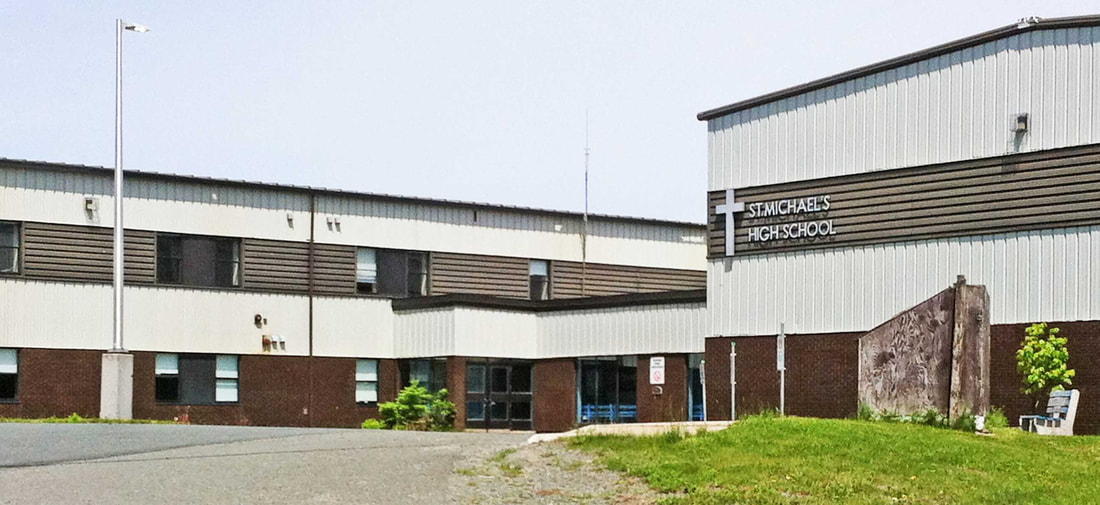
In the 1992-93 school year, Immaculate Conceptions Elementary had 320 students, while St. Michael's High School had 278 students.
In September 1995, Immaculate Conception had an enrolment of 247, while St. Michael's had 135 students. (Evening Telegram, Sept. 28, 1995)
When denominational education was abolished in Newfoundland & Labrador at the end of the 1997-98 school year, St. Boniface Anglican RHS closed and the former St. Michael's Roman Catholic High School became the Regional High School, serving all Bell Island's Grades 9 to 12 students. St. Augustine's became the Primary School serving Grades K to 3, while Immaculate Conception (the school built after the 1969 fire for Roman Catholic primary and elementary students) became the Elementary School, serving Grades 4 to 8 for all Bell Island students. (http://www.esdnl.ca/schools/schooldirectory/st_michaels_high/, accessed Aug. 29, 2009)
In 2003, St. Michael's High School had 250 students. (The Telegram, June 16, 2003, p. C11)
When Immaculate Conception closed in 2004, St. Augustine's then became the only Elementary School, serving Grades K to 6. St. Michael's then became a Grade 7 to 12 school. (Information from the St. Augustine's website, accessed Aug. 8, 2017)
In 2009, St. Michael's High School had 307 students. (http://www.esdnl.ca/schools/schooldirectory/st_michaels_high/, accessed Aug. 29, 2009)
In September 2025, St. Augustine's School had 128 pupils (staugustines.nlesd.ca/school-info, accessed Oct. 3, 2025); St. Michael's Regional High School had 133 pupils (https://www.nlschools.ca>schools>schoolprofile.jsp?id=189, accessed Oct. 3, 2025)
The photo of St. Michael's High School below was taken in 2020 by Gail Hussey-Weir.
Timeline of the Roman Catholic Schools on Bell Island
About 1875, there was said to be a woman conducting classes for Roman Catholic children in her home in the East End.
c. 1880s-1902, the Parish of St. Michael's had a one-room school on what became known as Court House Hill.
In the 1891 Census, there were 164 school children on Bell Island; this included both denominations.
By 1896, there was a Roman Catholic school in Lance Cove. (Now 2 R.C. schools on Bell Island.)
In 1898, the first Bell Island Roman Catholic School Board was appointed.
In 1901, St. Peter's one-room school opened on the Green to accommodate children in the growing "Mines" area of Bell Island. (Now 3 R.C. schools on Bell Island: Lance Cove, Court House Hill and the Green.)
In 1902, the R.C. Superior School replaced the former R.C. School on Court House Hill.
On November 5, 1913 Bell Island's first Catholic Cadet Corps was former at the Superior School on Court House Hill. It flourished for 10 years before disbanding.
By 1914, the Superior School had 75 pupils; the Lance Cove school had 50 pupils; the Mines school had 68 pupils; and the East End school had 53 pupils. (This was the first mention found of the East End School.) (Now 4 R.C. schools on Bell Island.)
In March 1915, the R.C. parishioners at the Mines formed a Parish Committee to raise funds for the building of a school [Immaculate Conception, opened in 1920] as the existing building [St. Peter's] was too small.
In September 1917, the first Sisters of Mercy came to Bell Island to teach. Archbishop Roche renamed the Superior School as St. Edward's, but it was too far from the Convent, so St. Edward's School was moved to St. Joseph's Hall at the Front. Presumably, the Superior School closed at that time. When this move took place, some children from the "Mines" area started attending this new school in spite of the long walk through boggy marshland next to the ore tramway. Enrollment was in excess of 100 pupils.
A project was launched on June 15, 1919, to build a Convent school at the Mines.
On September 24, 1920, Immaculate Conception School opened as a 4-room school on Town Square. At that time, St. Peter's on the Green ceased being used as a school.
In 1923, the foundation of a new R.C. school at Lance Cove was laid at the beginning of November.
In September 1926, R.C. ladies of West Mines formed an Auxilliary to raise funds for a new school in that section.
In October, 1926, the new Sacred Heart School at Lance Cove opened.
In November 1927, the new 2-room R.C. School at West Mines opened. (Now 5 R.C. schools on Bell Island: Sacred Heart, Lance Cove; St. Edward's, the Front; Immaculate Conception, Town Square; St. Theresa's, East End; and St. Cecilia's, West Mines.)
In October 1929, St. Edward's School opened as a girls' school in a new building across the street from St. Michael's Church, at the Front. St. Michael's boys' school then operated out of St. Joseph's Hall for the next nine years. St. Michael's had 116 students in 1929. (Now 6 R.C. schools on Bell Island, the 5 in 1927 plus the new St. Michael's at the Front.)
On July 13, 1930, the building that had been the Superior School until about 1917 was destroyed by fire.
In 1938, the new St. Michael's Boys' School building was opened at the Front, St. Kevin's Boys' School (2-rooms) was opened on Town Square, and a new St. Theresa's School opened at the East End. Sacred Heart School at Lance Cove and St. Cecilia's, West Mines, were also enlarged. As well "improvements and alterations" were made to St. Edward's, and three classrooms were added to Immaculate Conception School.
(Now 7 R.C. schools on Bell Island.)
In 1938, students of the Immaculate Conception School wore uniforms for the first time.
Dates unknown but "over the next few years, St. Kevin's [was said to have] received three further extensions to accommodate approximately 600 students. These extensions included a gymnasium and six outdoor handball courts."
"In 1943, the School Attendance Act was passed requiring children between the ages of 7 and 14 years to attend school every day that it was in session. In 1952, the upper age limit was raised to 15. The measure was not fully observed during the early years of its enactment because of lack of enforcement agencies." (Daily News, Dec. 31, 1963, p. 49)
In 1944, a whole new storey was added to Immaculate Conception School. It consisted of four extra classrooms, an assembly hall, library, commercial room, science room, two music rooms and a domestic science room. On December 8, 1944, the school was granted the status of an academy.
In the late 1940s, it is believed that the church that had been St. Peter's School originally, along with St. Peter's Hall on Theatre Avenue, burned to the ground.
In 1948, there were 1355 children attending Roman Catholic schools on Bell Island. The new Sacred Heart School at Lance Cove was completed that year, as was a new school at West Mines, and St. Theresa's School was extended to double its previous size. St. Theresa's now had 80 pupils. (From The Daily News, Dec. 31, 1948, p. 83)
About 1948, St. Michael's Boys' School at the Front closed. The older boys then attended St. Kevin's School and the younger boys up to Grade 5 attended St. Edward's. (Now 6 R.C. schools on Bell Island.)
When Newfoundland entered Confederation with Canada in 1949, it brought with it "the provision making the payment of Family Allowances dependent on school attendance." This resulted in marked improvements in attendance at schools throughout the province. (From The Daily News, Dec. 31, 1948, p. 83)
On August 30, 1950, when the Town of Wabana was incorporated, one of the building projects underway at the time was the second storey of St. Kevin's Boys' School.
On May 8, 1951, the St. Kevin's Roman Catholic Boys' School formed a Catholic Cadet Corps. At least during the 1950s, and perhaps longer, every St. Kevin's Boys' School student was required to join the Corps at age 13. It disbanded in 1978.
In 1953, St. Edward's School received a major extension, providing 11 classrooms, 2 music rooms, 2 laboratories, a library, reading room, teachers' conference room, principal's office and social room.
Sacred Heart School at Lance Cove received an extension of two rooms.
By 1958, St. Kevin's had 500 pupils in Grades 4 to 11.
In 1967, St. Theresa's School in the East End is believed to have closed.
June 30, 1966 saw the final shutdown of Wabana Mines, causing a major population exodus over the next few years.
In September 1967, Immaculate Conception Academy had a total of 600 students and 23 teachers. St. Edward's School at the Front had only 56 girls registered in the high school grades, so it was decided that the high school students from St. Edward's should attend classes at the Immaculate Conception Academy during the school year 1967-68.
In 1968, another reorganization took place. Girls up to and including Grade 6 and boys up to Grade 3 attended the Immaculate Conception Elementary School. St. Edwards became a central high school for girls from Grades 7 to 11. All boys from Grades 4 to 11 continued to attend St. Kevin's.
In 1969, the reorganization of school boards in Newfoundland took place following the report of the Warren Commission. Roman Catholic schools on Bell Island then came under the Roman Catholic School Board for St. John's.
In September 1969, the schools on the Island were completely reorganized by the School Board as a result of the decline in pupil population. According to Craig, "all schools were closed with the exception of": Immaculate Conception, which was designated as a kindergarten to Grade 8 girl's elementary school, St. Kevin's, kindergarten to Grade 8 boys elementary school, and St. Edward's a coeducational regional high school, accommodating boys and girls from Grades 9 to 11. (Now 3 R.C. schools)
On December 13, 1969, Immaculate Conception Academy on Town Square, as well as the church and convent, were destroyed by fire. The Sisters of Immaculate Conception Convent then moved into St. Edward's Convent. The majority of the displaced students were moved to St. Cecilia's School in West Mines and the rest went to St. Kevin's Boys' School, using a shift system until a new elementary school could be built. Up to this time, St. Kevin's had been an all-grade boys' school; it now became the Roman Catholic middle school for both genders, teaching Grades 7 to 9. St. Edward's at The Front then taught Grades 10 to 11 Roman Catholic students of both genders.
In 1972, the new Immaculate Conception Elementary School opened on the former site of the DOSCO Main Office on Bennett Street. St. Cecilia's School then closed for good.
In 1978, the Catholic Cadet Corps disbanded.
In 1981, Grade 12 was added to the Newfoundland and Labrador school curriculum.
On December 20, 1985, St. Michael's High School opened on Memorial Street; classes started in January 1986. St. Edward's closed at that time and was demolished shortly afterwards. St. Kevin's School on Town Square also closed at that time. (Now 2 R.C. Schools on Bell Island, St. Michael's High School and Immaculate Conception Elementary School.)
In the 1992-93 school year, Immaculate Conceptions Elementary had 320 students, while St. Michael's High School had 278 students.
In September 1995, Immaculate Conception had an enrolment of 247, while St. Michael's had 135 students. (Evening Telegram, Sept. 28, 1995)
At the end of the 1997-98 school year, denominational education was abolished in Newfoundland & Labrador. For all Bell Island students, the former Anglican St. Augustine's School then became the Primary School serving Grades K to 3, while Immaculate Conception became the Elementary School, serving Grades 4 to 8. St. Boniface [Anglican] Regional High School closed and St. Michael's became the Regional High School serving Grades 9 to 12 students. (http://www.esdnl.ca/schools/schooldirectory/st_michaels_high/, accessed Aug. 29, 2009)
In 2003, St. Michael's High School had 250 students. (The Telegram, June 16, 2003, p. C11)
In 2004, the Immaculate Conception School closed, at which time St. Augustine's became the only Elementary School for Bell Island, serving Grades K to 6. St. Michael's then became a Grades 7 to 12 school. (Information from the St. Augustine's website, accessed Aug. 8, 2017)
In 2009, St. Michael's High School had 307 students. students. (http://www.esdnl.ca/schools/schooldirectory/st_michaels_high/, accessed Aug. 29, 2009)
In September 2025, St. Augustine's School had 128 pupils (staugustines.nlesd.ca/school-info, accessed Oct. 3, 2025); St. Michael's Regional High School had 133 pupils (https://www.nlschools.ca>schools>schoolprofile.jsp?id=189, accessed Oct. 3, 2025)
c. 1880s-1902, the Parish of St. Michael's had a one-room school on what became known as Court House Hill.
In the 1891 Census, there were 164 school children on Bell Island; this included both denominations.
By 1896, there was a Roman Catholic school in Lance Cove. (Now 2 R.C. schools on Bell Island.)
In 1898, the first Bell Island Roman Catholic School Board was appointed.
In 1901, St. Peter's one-room school opened on the Green to accommodate children in the growing "Mines" area of Bell Island. (Now 3 R.C. schools on Bell Island: Lance Cove, Court House Hill and the Green.)
In 1902, the R.C. Superior School replaced the former R.C. School on Court House Hill.
On November 5, 1913 Bell Island's first Catholic Cadet Corps was former at the Superior School on Court House Hill. It flourished for 10 years before disbanding.
By 1914, the Superior School had 75 pupils; the Lance Cove school had 50 pupils; the Mines school had 68 pupils; and the East End school had 53 pupils. (This was the first mention found of the East End School.) (Now 4 R.C. schools on Bell Island.)
In March 1915, the R.C. parishioners at the Mines formed a Parish Committee to raise funds for the building of a school [Immaculate Conception, opened in 1920] as the existing building [St. Peter's] was too small.
In September 1917, the first Sisters of Mercy came to Bell Island to teach. Archbishop Roche renamed the Superior School as St. Edward's, but it was too far from the Convent, so St. Edward's School was moved to St. Joseph's Hall at the Front. Presumably, the Superior School closed at that time. When this move took place, some children from the "Mines" area started attending this new school in spite of the long walk through boggy marshland next to the ore tramway. Enrollment was in excess of 100 pupils.
A project was launched on June 15, 1919, to build a Convent school at the Mines.
On September 24, 1920, Immaculate Conception School opened as a 4-room school on Town Square. At that time, St. Peter's on the Green ceased being used as a school.
In 1923, the foundation of a new R.C. school at Lance Cove was laid at the beginning of November.
In September 1926, R.C. ladies of West Mines formed an Auxilliary to raise funds for a new school in that section.
In October, 1926, the new Sacred Heart School at Lance Cove opened.
In November 1927, the new 2-room R.C. School at West Mines opened. (Now 5 R.C. schools on Bell Island: Sacred Heart, Lance Cove; St. Edward's, the Front; Immaculate Conception, Town Square; St. Theresa's, East End; and St. Cecilia's, West Mines.)
In October 1929, St. Edward's School opened as a girls' school in a new building across the street from St. Michael's Church, at the Front. St. Michael's boys' school then operated out of St. Joseph's Hall for the next nine years. St. Michael's had 116 students in 1929. (Now 6 R.C. schools on Bell Island, the 5 in 1927 plus the new St. Michael's at the Front.)
On July 13, 1930, the building that had been the Superior School until about 1917 was destroyed by fire.
In 1938, the new St. Michael's Boys' School building was opened at the Front, St. Kevin's Boys' School (2-rooms) was opened on Town Square, and a new St. Theresa's School opened at the East End. Sacred Heart School at Lance Cove and St. Cecilia's, West Mines, were also enlarged. As well "improvements and alterations" were made to St. Edward's, and three classrooms were added to Immaculate Conception School.
(Now 7 R.C. schools on Bell Island.)
In 1938, students of the Immaculate Conception School wore uniforms for the first time.
Dates unknown but "over the next few years, St. Kevin's [was said to have] received three further extensions to accommodate approximately 600 students. These extensions included a gymnasium and six outdoor handball courts."
"In 1943, the School Attendance Act was passed requiring children between the ages of 7 and 14 years to attend school every day that it was in session. In 1952, the upper age limit was raised to 15. The measure was not fully observed during the early years of its enactment because of lack of enforcement agencies." (Daily News, Dec. 31, 1963, p. 49)
In 1944, a whole new storey was added to Immaculate Conception School. It consisted of four extra classrooms, an assembly hall, library, commercial room, science room, two music rooms and a domestic science room. On December 8, 1944, the school was granted the status of an academy.
In the late 1940s, it is believed that the church that had been St. Peter's School originally, along with St. Peter's Hall on Theatre Avenue, burned to the ground.
In 1948, there were 1355 children attending Roman Catholic schools on Bell Island. The new Sacred Heart School at Lance Cove was completed that year, as was a new school at West Mines, and St. Theresa's School was extended to double its previous size. St. Theresa's now had 80 pupils. (From The Daily News, Dec. 31, 1948, p. 83)
About 1948, St. Michael's Boys' School at the Front closed. The older boys then attended St. Kevin's School and the younger boys up to Grade 5 attended St. Edward's. (Now 6 R.C. schools on Bell Island.)
When Newfoundland entered Confederation with Canada in 1949, it brought with it "the provision making the payment of Family Allowances dependent on school attendance." This resulted in marked improvements in attendance at schools throughout the province. (From The Daily News, Dec. 31, 1948, p. 83)
On August 30, 1950, when the Town of Wabana was incorporated, one of the building projects underway at the time was the second storey of St. Kevin's Boys' School.
On May 8, 1951, the St. Kevin's Roman Catholic Boys' School formed a Catholic Cadet Corps. At least during the 1950s, and perhaps longer, every St. Kevin's Boys' School student was required to join the Corps at age 13. It disbanded in 1978.
In 1953, St. Edward's School received a major extension, providing 11 classrooms, 2 music rooms, 2 laboratories, a library, reading room, teachers' conference room, principal's office and social room.
Sacred Heart School at Lance Cove received an extension of two rooms.
By 1958, St. Kevin's had 500 pupils in Grades 4 to 11.
In 1967, St. Theresa's School in the East End is believed to have closed.
June 30, 1966 saw the final shutdown of Wabana Mines, causing a major population exodus over the next few years.
In September 1967, Immaculate Conception Academy had a total of 600 students and 23 teachers. St. Edward's School at the Front had only 56 girls registered in the high school grades, so it was decided that the high school students from St. Edward's should attend classes at the Immaculate Conception Academy during the school year 1967-68.
In 1968, another reorganization took place. Girls up to and including Grade 6 and boys up to Grade 3 attended the Immaculate Conception Elementary School. St. Edwards became a central high school for girls from Grades 7 to 11. All boys from Grades 4 to 11 continued to attend St. Kevin's.
In 1969, the reorganization of school boards in Newfoundland took place following the report of the Warren Commission. Roman Catholic schools on Bell Island then came under the Roman Catholic School Board for St. John's.
In September 1969, the schools on the Island were completely reorganized by the School Board as a result of the decline in pupil population. According to Craig, "all schools were closed with the exception of": Immaculate Conception, which was designated as a kindergarten to Grade 8 girl's elementary school, St. Kevin's, kindergarten to Grade 8 boys elementary school, and St. Edward's a coeducational regional high school, accommodating boys and girls from Grades 9 to 11. (Now 3 R.C. schools)
On December 13, 1969, Immaculate Conception Academy on Town Square, as well as the church and convent, were destroyed by fire. The Sisters of Immaculate Conception Convent then moved into St. Edward's Convent. The majority of the displaced students were moved to St. Cecilia's School in West Mines and the rest went to St. Kevin's Boys' School, using a shift system until a new elementary school could be built. Up to this time, St. Kevin's had been an all-grade boys' school; it now became the Roman Catholic middle school for both genders, teaching Grades 7 to 9. St. Edward's at The Front then taught Grades 10 to 11 Roman Catholic students of both genders.
In 1972, the new Immaculate Conception Elementary School opened on the former site of the DOSCO Main Office on Bennett Street. St. Cecilia's School then closed for good.
In 1978, the Catholic Cadet Corps disbanded.
In 1981, Grade 12 was added to the Newfoundland and Labrador school curriculum.
On December 20, 1985, St. Michael's High School opened on Memorial Street; classes started in January 1986. St. Edward's closed at that time and was demolished shortly afterwards. St. Kevin's School on Town Square also closed at that time. (Now 2 R.C. Schools on Bell Island, St. Michael's High School and Immaculate Conception Elementary School.)
In the 1992-93 school year, Immaculate Conceptions Elementary had 320 students, while St. Michael's High School had 278 students.
In September 1995, Immaculate Conception had an enrolment of 247, while St. Michael's had 135 students. (Evening Telegram, Sept. 28, 1995)
At the end of the 1997-98 school year, denominational education was abolished in Newfoundland & Labrador. For all Bell Island students, the former Anglican St. Augustine's School then became the Primary School serving Grades K to 3, while Immaculate Conception became the Elementary School, serving Grades 4 to 8. St. Boniface [Anglican] Regional High School closed and St. Michael's became the Regional High School serving Grades 9 to 12 students. (http://www.esdnl.ca/schools/schooldirectory/st_michaels_high/, accessed Aug. 29, 2009)
In 2003, St. Michael's High School had 250 students. (The Telegram, June 16, 2003, p. C11)
In 2004, the Immaculate Conception School closed, at which time St. Augustine's became the only Elementary School for Bell Island, serving Grades K to 6. St. Michael's then became a Grades 7 to 12 school. (Information from the St. Augustine's website, accessed Aug. 8, 2017)
In 2009, St. Michael's High School had 307 students. students. (http://www.esdnl.ca/schools/schooldirectory/st_michaels_high/, accessed Aug. 29, 2009)
In September 2025, St. Augustine's School had 128 pupils (staugustines.nlesd.ca/school-info, accessed Oct. 3, 2025); St. Michael's Regional High School had 133 pupils (https://www.nlschools.ca>schools>schoolprofile.jsp?id=189, accessed Oct. 3, 2025)
Some Questions and Observations
Here are some questions and observations that came to mind while I was writing this history of RC Schools on Bell Island:
When did St. Theresa's School, East End, first open?
What year did the first St. Michael's School at the Front, close?
When were the following schools taken down: St. Kevin's on Town Square, St. Cecilia's at West Mines, Sacred Heart in Lance Cove, and Immaculate Conception on Bennett Street?
Did Sacred Heart in Lance Cove and St. Cecilia's in West Mines teach all grades, or did the students move to the schools on Town Square and/or St. Edward's for the higher grades?
After the Sisters of Mercy came to Bell Island in 1917, did they take any part in teaching at the RC School in Lance Cove or the East End, or in the school at West Mines when it was established?
It is not clear if all the schools were given a name when they were first built as most reports simply refer to them as "East End school, West Mines school, Lance Cove school, etc.
You will notice that reports on the schools over the years often refer to "a new school" being built in one area of Bell Island or another. In some cases the report says that additional classrooms were added to the already existing school, but in other cases, it is described as "a new school under construction" where we know from previous reporting that there was already a smaller school in that area. It is never made clear if this "new school" was an add-on to the previous school, or if it was built next to it, or in another location altogether. If anyone has any knowledge of this or answers to any other of the above questions, please get in touch at: [email protected]
When did St. Theresa's School, East End, first open?
What year did the first St. Michael's School at the Front, close?
When were the following schools taken down: St. Kevin's on Town Square, St. Cecilia's at West Mines, Sacred Heart in Lance Cove, and Immaculate Conception on Bennett Street?
Did Sacred Heart in Lance Cove and St. Cecilia's in West Mines teach all grades, or did the students move to the schools on Town Square and/or St. Edward's for the higher grades?
After the Sisters of Mercy came to Bell Island in 1917, did they take any part in teaching at the RC School in Lance Cove or the East End, or in the school at West Mines when it was established?
It is not clear if all the schools were given a name when they were first built as most reports simply refer to them as "East End school, West Mines school, Lance Cove school, etc.
You will notice that reports on the schools over the years often refer to "a new school" being built in one area of Bell Island or another. In some cases the report says that additional classrooms were added to the already existing school, but in other cases, it is described as "a new school under construction" where we know from previous reporting that there was already a smaller school in that area. It is never made clear if this "new school" was an add-on to the previous school, or if it was built next to it, or in another location altogether. If anyone has any knowledge of this or answers to any other of the above questions, please get in touch at: [email protected]